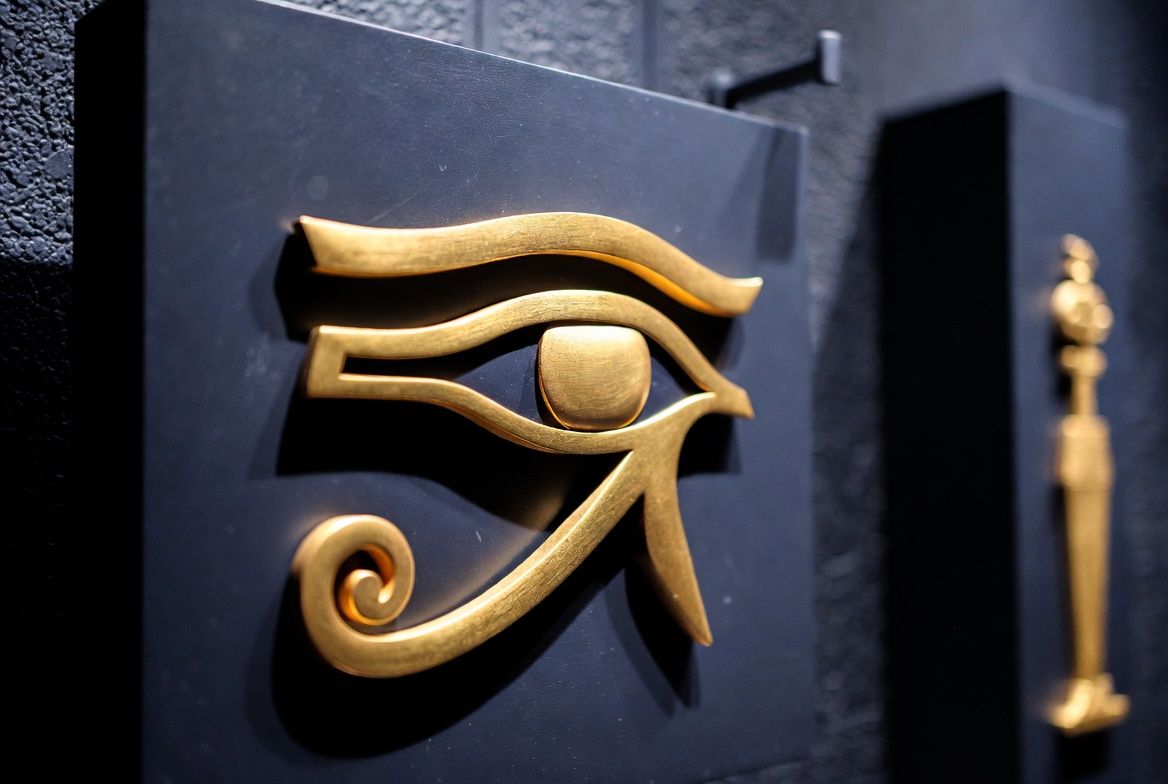
Eye of Horus IS the Pineal Gland? Mayo Clinic Answered This in 2019
You’ve probably seen the image. A sagittal cross-section of the human brain — the kind you’d find in any neuroanatomy textbook — laid over the Eye of Horus. The structures line up. Suspiciously well.
Is that a real correspondence, or is it the kind of pattern the human brain projects onto anything with enough geometric complexity? We’re wired to find faces in clouds and meaning in noise. That’s not a flaw — it’s how we survived. It also makes evaluating ancient symbols genuinely hard.
I’m going to separate the two things here. What the archaeological record actually shows. What neuroscience actually says. And where the line between intriguing coincidence and documented fact gets blurry — because it does — and where a lot of people in this space quietly stop being honest.
Is the Eye of Horus the Pineal Gland?
Not exactly — but the visual overlap is real, and it’s been confirmed by people who know brains for a living.
In 2019, a team of neurosurgeons from the Mayo Clinic — ReFaey, Quinones, Clifton, Tripathi, and Quiñones-Hinojosa — published a peer-reviewed paper in Cureus documenting what happens when you overlay the Eye of Horus onto a sagittal brain image. Each of the symbol’s six component parts maps onto a specific sensory center: the olfactory trigone, the thalamus, the corpus callosum, Brodmann areas 41 and 42 for audition, and somatosensory pathways for taste and touch.
That’s not a casual observation. That’s Mayo Clinic neurosurgeons publishing in a medical journal.
But here’s what those same authors wrote: “we acknowledge that a portion of the findings are not based on a scientific explanation but rather on a hypothesis.”
Visual correspondence is real. Intentional Egyptian anatomical knowledge is not proven. Those are different claims. Conflating them is where most content on this topic goes wrong.
What Does the Eye of Horus Represent?
Protection. Healing. Royal power. That’s the documented function, going back roughly 3,000 BCE.
The symbol has six parts, each representing a fraction of the Heqat — the ancient Egyptian grain measurement system: 1/2, 1/4, 1/8, 1/16, 1/32, and 1/64. They sum to 63/64. The missing 1/64 was attributed to Thoth, god of knowledge, who made up the difference by magic. Make of that what you will.
The mythological origin is a war story. Set tears out Horus’s eye during battle. Thoth restores it. The restored eye — wedjat, meaning “the whole one” — becomes a symbol of healing and completeness that persists across thousands of years of Egyptian culture.
One distinction that trips up nearly every article in this space: the Eye of Horus and the Eye of Ra are not the same symbol. The Eye of Ra is solar, aggressive, associated with the destructive face of the sun goddess. The Eye of Horus is lunar, protective, healing. Related iconographically, different mythologically. If something you’re reading treats them as interchangeable, that’s a reliable signal about the quality of the sourcing.
Did Ancient Egyptians Know About the Pineal Gland?
No — not in any form we can document.
The Edwin Smith Papyrus, dated to around 1600 BCE but believed to copy a source from roughly 3000 BCE, is the oldest known medical text in human history. It contains the first written use of the word “brain,” early descriptions of the meninges, and observations about cerebrospinal fluid. Forty-eight cases of traumatic injury, analyzed with a methodical clinical approach that’s genuinely striking for its era.
And yet — consciousness, thought, perception — all located in the heart. Not the brain.
The Ebers Papyrus (~1550 BCE), 700 medical formulas, same story. The heart is the center of mind and self. The brain barely registers.
Here’s the detail that settles the question more than any text does: the Egyptians removed the brain during mummification. Pulled it out through the nose with hooks. Discarded it. The heart was carefully preserved in a canopic jar. That’s not the behavior of a civilization that believed the brain housed consciousness, let alone a specific 8mm gland inside it.
The modern claim — that Egyptians consciously encoded neuroanatomy into the Eye of Horus — was popularized largely through R.A. Schwaller de Lubicz’s Sacred Science (1961), after he spent 12 years studying the temples at Thebes. Genuinely compelling work. Also built, critics argue, on foundations shaped by his prior esoteric commitments rather than strict archaeological method.
“We don’t know” is not the same as “they knew.” That’s speculation, not history.
Why Does the Eye of Horus Look Like the Brain?
Here’s the specific mapping that keeps circulating, laid out plainly:
- Pupil → pineal gland
- Brow/eyebrow curve → corpus callosum
- Teardrop marking → pituitary gland
- Iris area → thalamus
- Lateral extension → brainstem
Striking. And I’ll admit — when I first encountered the ReFaey paper years ago, I found this more convincing than I do now.
The problem is methodological. The human brain has hundreds of distinct structures, curves, and protrusions. Any symbol with sufficient geometric complexity can be made to “map” onto brain anatomy if you have freedom to choose which structures to match and which to skip. Psychologists call this apophenia — pattern detection applied to noise. The human brain is, somewhat ironically, extraordinarily good at it.
That critique doesn’t invalidate the ReFaey study — their mapping is systematic, not arbitrary. But the correspondence alone can’t tell us whether Egyptian artists were encoding anatomy or whether we’re reading anatomy backward onto art.
Both could be partially true. That’s the uncomfortable answer, and it’s the only honest one available.

The Pineal Gland Across Ancient Cultures
The Eye of Horus case is the most discussed, but it’s not isolated. Multiple traditions across thousands of years and thousands of miles converged on the same general region of the skull as a locus of higher perception.
Ancient India. Patanjali’s Yoga Sutras (~400 BCE) describe dharana — sustained concentration on the space between the eyebrows — as a technique for accessing higher states of perception. The Shiva Samhita (15th century CE) names Ajna as a command center. Ajna means “to perceive” or “to command” in Sanskrit. The step of mapping this chakra onto the physical pineal gland happened in the 20th century, not in the original texts — which describe a subtle energetic structure, not an anatomical one.
Descartes. René Descartes called the pineal gland the conarion and named it the “principal seat of the rational soul.” His reason for choosing it: it was the only structure in the brain not duplicated in bilateral pairs, and therefore — he argued — uniquely able to unify the two streams of sensory input. He was wrong about the mechanism. He thought the pineal floated in the ventricles and redirected “animal spirits.” But he picked the right structure for a reason that turns out to be anatomically real: it genuinely is the only unpaired structure in the brain.
Mesoamerica. Some researchers point to forehead-eye imagery associated with Quetzalcóatl in Teotihuacán iconography. I looked for a verified primary archaeological source connecting this to a third-eye concept. I didn’t find one. Treat it as speculative until someone produces better evidence — which I’d genuinely like to see.
What Is the Pineal Gland, Actually?
A pine-cone-shaped gland — that’s literally where the name comes from, Latin pinus — sitting at the geometric center of the brain. About 8mm long. Roughly 150mg. Unremarkable to look at.
Its confirmed function is melatonin production. Melatonin regulates your circadian rhythm in response to light signals relayed from the retina — it’s how your brain tracks day and night. That function wasn’t even identified until 1958, when dermatologist Aaron Lerner isolated melatonin for the first time. Before that, nobody knew what the pineal did. Which is a significant part of why it became such a powerful blank canvas for projection.
The pineal gland is the only unpaired structure in the human brain — positioned precisely at the geometric center of the head, a fact that made it architecturally singular long before any spiritual tradition assigned it meaning.
Every other brain structure comes in bilateral pairs. The pineal doesn’t. Descartes noticed this in 1640 and made it the cornerstone of a whole theory of consciousness. Whether or not his theory was right, the observation was accurate.
If your pineal is calcifying — which happens to most adults and may affect melatonin output — that’s worth understanding on its own terms.
Does the Pineal Gland Have Spiritual Functions?
Science doesn’t know. Anyone who tells you otherwise is working past the data.
Here’s what’s actually documented. The pineal produces melatonin. It contains high concentrations of INMT — the enzyme required to synthesize DMT, the compound found in plant-based psychedelics. A 2018 review in Frontiers in Neuroscience found evidence of DMT in rat pineal tissue. That was enough to fuel years of “spirit molecule” claims.
Then, a February 2026 study found no detectable DMT in adult rat brains even under optimal conditions — including metabolic blockade so any DMT present would accumulate and become detectable. Zero. Below the limit of detection. That result doesn’t close the question entirely, but it substantially weakens the pineal-DMT hypothesis as it’s usually presented.
What contemplative traditions document across cultures and centuries is something different from biochemistry: that practices targeting the space between the eyes — meditation, pranayama, certain forms of prayer — reliably produce states of consciousness that feel categorically different from ordinary waking experience. That’s a consistent phenomenological finding regardless of mechanism. The mechanism is genuinely unknown.
The more interesting question isn’t whether the pineal gland is “spiritual.” It’s this: if a 3-pound organ running on 20 watts can generate experiences that feel more real than ordinary reality, what does that actually say about the relationship between consciousness and matter?
I don’t have that answer. Start here if you’re exploring the practices: what the evidence actually supports about third eye development.

Pineal Guardian is what I use for physiological support while exploring that question — not because it answers it, but because the calcification research is solid enough to take seriously.
Frequently Asked Questions
Is the Eye of Horus the pineal gland?
Did ancient Egyptians know about the pineal gland?
What does the Eye of Horus represent?
What cultures believed in a third eye?
What is the pineal gland's actual function?
Why does the Eye of Horus look like the brain?
Is the Eye of Ra connected to the pineal gland?
What did ancient Egypt say about the third eye?
What This Means
Five independent civilizations — separated by centuries and thousands of miles — developed symbolic systems pointing toward the same small structure at the center of the human skull. Some named it explicitly. Some encoded it in geometry. Some built entire contemplative traditions around accessing whatever they believed resided there.
That convergence might be coincidence. It might be altered states — meditation, ritual, plant medicine — producing consistent phenomenological landmarks that different cultures described in different vocabularies. It might be something else.
The question isn’t whether to believe or not believe. It’s why so much of humanity’s symbolic inheritance keeps pointing at the same 8mm of tissue.
That’s worth sitting with. And if you want to understand what’s happening in that tissue right now — the symptoms of pineal gland changes are more detectable than most people realize.
Disclosure: Marcus Hale is an independent researcher. Nothing on PinealCode.com constitutes medical advice. If you have concerns about sleep, circadian rhythm, or neurological function, consult a licensed healthcare provider.

Marcus Hale
Independent Researcher · Former Clinical Neuroscientist
I spent 12 years in clinical neurology before the questions got more interesting than the answers. PinealCode is where I document what I find at the intersection of brain science and consciousness.