Third Eye Opening Symptoms: What's Real and What Isn't
By Marcus Hale·
Something is pressing between your eyebrows. Not painful — just there. You’ve been meditating more, sleeping differently, and your dreams have started feeling less like noise and more like messages.
Thousands of people report these exact things. Every week, new threads appear on Reddit and spiritual forums where people describe the same cluster of sensations — pressure, vivid dreams, déjà vu that won’t quit, and an intuition that suddenly has an edge to it.
Nobody can fully explain what’s happening.
Third eye opening symptoms are real as experiences. Whether they map to a single anatomical or spiritual event is a different question entirely — and anyone who tells you they know for certain is selling something.
What I can do is show you what the science actually touches, where it goes silent, and how to read your own experience more clearly.
Third eye opening symptoms: pressure between eyebrows, vivid dreams, heightened intuition — real experiences reported across cultures, with partial scientific explanations (melatonin, attention science) and significant unknowns.
What Are Third Eye Opening Symptoms?
Third eye opening symptoms are the physical, mental, and perceptual changes that practitioners report during periods of focused spiritual or meditative practice — most commonly pressure between the eyebrows, heightened dream activity, increased sensory sensitivity, and a sharpening of intuition.
The “third eye” sits at the intersection of two very different maps.
In yogic and Hindu traditions, it’s the Ajna chakra — the sixth energy center, located at the forehead between the eyes. Considered the seat of intuition, inner vision, and perception beyond the ordinary senses. Tibetan Buddhism has its own version. So does Taoism. The imagery is ancient and consistent across cultures that never compared notes.
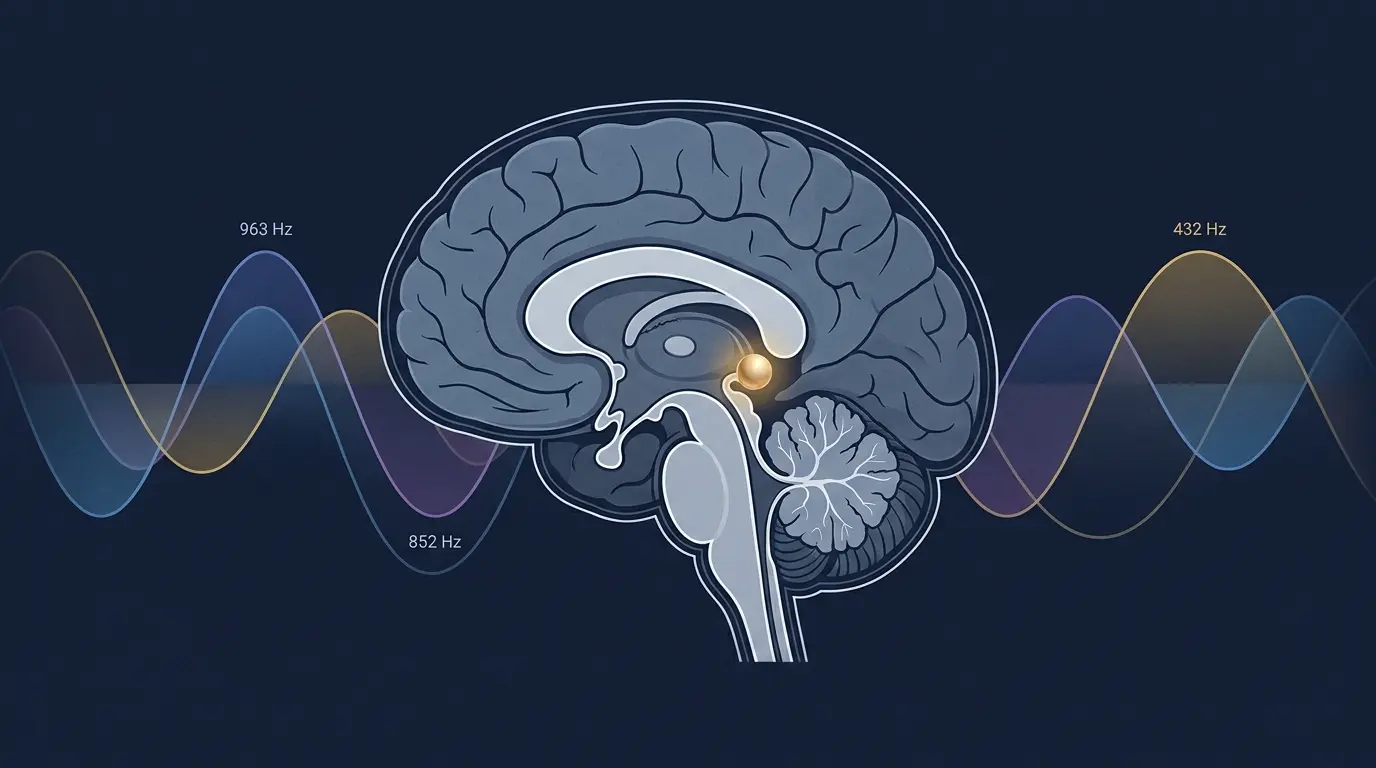
The anatomical candidate is the pineal gland. A small, pine-cone-shaped structure sitting near the center of the brain. It weighs roughly 100 to 150 milligrams, according to Arendt and Aulinas (2022). In some reptiles and fish, it’s literally a photoreceptive organ — a functional third eye with a lens and photoreceptors. In humans, it lost that direct light sensitivity somewhere along the evolutionary timeline, but kept a deep relationship with light cycles through the retinohypothalamic tract.
Here’s the problem with “symptoms”: there’s no clinical definition. No peer-reviewed study has ever validated “third eye activation” as a diagnosable or measurable event.
That doesn’t mean the experiences aren’t real. It means we’re working without a map for this specific terrain. What people report as third eye opening symptoms exist in a gray zone between neuroscience, attention science, and subjective phenomenology — and collapsing that gray zone in either direction is intellectually dishonest.
The Most Commonly Reported Third Eye Opening Symptoms
Physical Symptoms
Pressure between the eyebrows. That’s the one. On forums like r/Meditation and r/Awakened, it comes up more than anything else — described as a “finger pressing from the inside,” a warmth, a pulse, sometimes a mild ache that sits right at the glabella. If you want a deeper breakdown of that sensation specifically, the full picture is more complicated than most sources admit.
Then headaches. Frontal, low-grade, not the kind that puts you in bed — more like a background hum concentrated between the eyes and occasionally drifting toward the crown. They tend to track with meditation intensity.
Sensitivity spikes too. Sound becomes sharper. Light that never bothered you now does. Some people report tingling at the top of the skull during or after deep meditation — described as “opening” or “buzzing,” depending on who’s talking.
None of these are unique to spiritual practice. Stress, screen time, and poor sleep produce similar sensations. But their consistent clustering during periods of intentional inner work is hard to dismiss entirely.
Mental & Emotional Symptoms
Mental clarity that feels almost foreign. Like static you’d accepted as background noise suddenly gets quieter. Not for everyone — a significant portion of people report confusion first, a disorientation in the early stages before anything settles.
Emotional intensity picks up. Things you thought you’d processed come back with unexpected force. Dreams change — longer, more coherent, stranger, more memorable. Déjà vu becomes more frequent and more specific, like you’re recognizing not just places but moments.
Sleep disruption is common in the early phases. Which creates a feedback loop worth paying attention to, because disrupted sleep affects melatonin, and melatonin is central to how the pineal gland functions. These things aren’t separate.
Perceptual & Spiritual Symptoms
Intuition sharpens. Not mystically — practically. You read rooms differently. Patterns in conversations become more visible. Something feels off before you can articulate why.
Synchronicities start stacking. You can argue that you’re just noticing more. That’s probably part of it. I used to be fairly confident that was all of it — until I started paying closer attention to what I was actually dismissing. The frequency of these reports, across wildly different cultural contexts, is harder to write off than I initially gave it credit for.
Eyes closed, some people begin seeing geometric patterns, phosphenes, or shifting colors — particularly in low-stimulation environments. Others describe a growing sensitivity to the emotional states of people around them, almost like the signal-to-noise ratio on empathy has changed.
Spontaneous visual phenomena during meditation have been documented anecdotally across traditions for thousands of years. We don’t have neuroimaging studies examining what’s actually happening in the brain during these specific perceptual shifts. That’s a real gap.
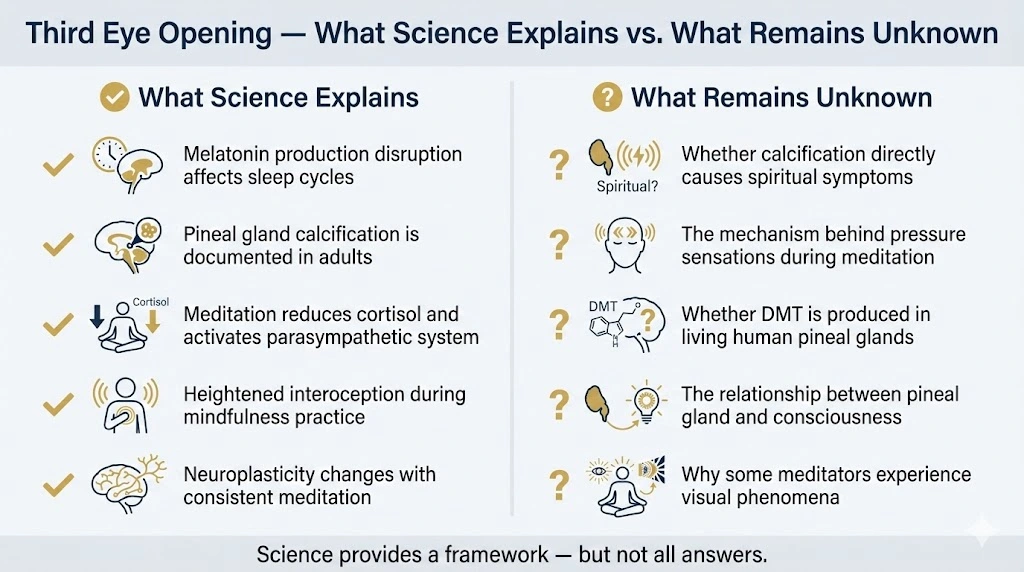
What science explains (melatonin, calcification, frontalis muscle tension) vs what remains unknown (DMT production, spontaneous visual phenomena, intuition sharpening) — honest mapping of the evidence gap.
What Science Can (and Can’t) Explain
The pineal gland’s primary known function is melatonin production. Synthesis peaks between 2 and 4 a.m., according to Arendt and Aulinas (2022), and is directly suppressed by blue light in the 460–480 nm range — even at intensities below 200 lux. That’s less light than most people have in their bedroom at 10 p.m.
Calcification is where it gets more concerning. A 2018 analysis published in Molecules by Tan, Xu, Zhou, and Reiter found that the pineal gland has the highest calcification rate of any organ in the body. 62% of patients showed calcification in CT scans, with an average age of 58.7 years. But 83% of subjects over 30 showed some degree of it. And calcification correlates with reduced melatonin — including in the cerebrospinal fluid of Alzheimer’s patients, where levels dropped to roughly 20% of healthy controls.
For the pressure between the eyebrows — the most reported symptom — science has a partial answer. A heavily upvoted comment on r/Meditation put it plainly: “You’re just tensing your forehead from focus — try relaxing your face muscles.” That’s not dismissive. It’s accurate for a meaningful percentage of cases. Sustained attentional focus activates the frontalis muscle. The trigeminal nerve runs through that region. Somatic awareness during meditation naturally amplifies subtle sensations you normally ignore.
Does that explain all of it?
No. Probably not. The same researchers who wrote the 2018 calcification paper noted that the pineal gland produces DMT — but were explicit that the biological consequences in living humans still require significant clarification. That’s not a footnote. That’s an enormous open question dressed up in careful academic language.
And no neuroimaging study has investigated what happens in the prefrontal or midbrain regions during the specific cluster of experiences people call “third eye activation.” That research doesn’t exist yet. Which is itself a strange omission, given how consistently these experiences are reported.
Are These Symptoms a Sign Something Is Wrong?
Most of what people describe is benign and temporary.
Pressure between the eyebrows, mild frontal headaches, vivid dreams, increased sensitivity — transient in the overwhelming majority of cases. They shift with sleep, stress, hydration, and meditation intensity. They don’t escalate.
But some things warrant a real conversation with a doctor.
Severe or persistent headaches — especially with visual disturbances, nausea, or neurological symptoms — are not spiritual activation. They require evaluation. Same for sudden onset of vision changes, tinnitus that doesn’t resolve, or cognitive disruption that interferes with daily function.
The distinction is duration and severity. Passing pressure during meditation is different from a headache that lasts three days. Vivid dreams during a period of focused practice are different from weeks of disrupted sleep with no recovery.
Use basic judgment. These experiences are worth paying attention to — not a reason to avoid medical care when something feels genuinely wrong.
How to Support Your Pineal Gland During Activation
Sleep is the foundation. Not an optimization strategy — the actual base layer. Melatonin production happens in darkness, in the hours before 4 a.m., and it’s directly sabotaged by light exposure after sunset. Getting this right matters more than any supplement, any practice, any protocol.
Reduce fluoride exposure where reasonable. Filtered water, reduced fluoridated toothpaste use. Small moves that compound over time. The science on fluoride and the pineal gland is more solid than most people realize.
Morning sunlight is legitimate neuroscience. Ten to twenty minutes of natural light within an hour of waking anchors circadian rhythm, which directly affects when and how much melatonin you produce at night — the mechanism is well-documented via the retinohypothalamic tract.
Meditation, especially practices involving focused attention at the forehead or breath awareness, creates the conditions where these perceptual shifts tend to emerge. Consistency matters more than duration.
Pineal support fundamentals: quality sleep in total darkness, morning sunlight exposure, fluoride reduction, consistent meditation — targeted supplementation (Lion’s Mane, Bacopa, Pine Bark) complements, not replaces, these foundations.
If you want targeted support for pineal function alongside the fundamentals, Pineal Guardian is formulated around the ingredients most commonly linked to calcification reduction and melatonin support. It’s not a shortcut — it’s a complement to what you’re already doing.
Frequently Asked Questions
How long do third eye opening symptoms last?
The physical symptoms — pressure and sensitivity especially — tend to be tied to meditation sessions and resolve within hours. The perceptual and mental shifts accumulate gradually over weeks to months. There's no reliable timeline because the experience depends heavily on how consistent the underlying practices are.
Can third eye opening symptoms be dangerous?
In typical form, no. Intense meditation can surface difficult emotional material — grief, anxiety, old memories with new weight. If physical symptoms are severe, persistent, or accompanied by neurological changes — vision disturbances, significant disorientation, headaches that won't break — get it evaluated medically.
Does everyone experience the same third eye opening symptoms?
No. The pressure between the eyebrows is the most commonly reported across cultures and forums, but beyond that, the experience is individual. Some people report nothing physical at all and describe the shift as purely perceptual. There's no universal script.
Is pressure between the eyebrows always a third eye symptom?
Not automatically. Muscle tension from sustained concentration is a documented physical phenomenon. Stress, eye strain, and sinus pressure produce similar sensations. Context matters — pressure that emerges consistently during meditation and resolves after is a different profile from tension headaches driven by screen time.
Can you speed up third eye opening?
I'd reframe the question. The conditions that support deeper perception — quality sleep, reduced calcification, consistent meditation, lower stress load — are things you can actively work on. But treating activation like a timer you can fast-forward tends to produce more grasping than clarity. The practices matter more than the pace.
What are the first signs your third eye is opening?
Most commonly: pressure or pulsing between the eyebrows during meditation, increased dream vividness, heightened sensitivity to light or sound, and a subtle sharpening of intuition. These can also have mundane explanations — muscle tension, sleep changes, attention shift. Context and consistency are what make them meaningful.
Wrapping Up
Third eye opening symptoms are real as experiences. Thousands of people across different cultures and backgrounds report the same cluster of sensations — and dismissing that wholesale is as intellectually lazy as accepting every explanation without scrutiny.
Here’s what’s honest: science touches the edges of this. Melatonin, calcification, attentional focus, circadian rhythm — real mechanisms with real research behind them. The core of what people call “activation” remains outside current research frameworks. That might change. The DMT question alone is worth watching.
Start with the fundamentals. Protect your sleep. Cut light exposure at night. Get morning sun. Meditate consistently. If you want targeted support for your pineal, check what Pineal Guardian is actually made of — and decide from there.
The rest unfolds on its own schedule. If you’re just getting started, how to open your third eye is the right next read.
Medical Disclaimer: The content on
PinealCode.com is for informational and educational purposes only. Nothing here
constitutes medical advice, diagnosis, or treatment. Always consult a qualified
healthcare provider before making changes to your health regimen.
Marcus Hale
Independent Researcher · Former Clinical Neuroscientist
I spent 12 years in clinical neurology before the questions got more interesting
than the answers. PinealCode is where I document what I find at the intersection
of brain science and consciousness.