How to Open Your Third Eye: What Science Actually Found
By Marcus Hale·
Here’s the strange part: science didn’t find the third eye where traditions said it was.
Twelve years digging through brain imaging labs taught me something. The pineal gland is real. Melatonin production is measurable. Circadian rhythms are biochemistry. But the actual mechanism behind what happens when someone meditates for months and reports clarity they’ve never experienced — that lives somewhere else entirely.
Traditions observed something real. The Hatha Yoga Pradipika documented ajna chakra practices in the 15th century with precision. Buddhist iconography placed the urna (third eye) at the center of consciousness. Hindu tantric texts treated this point as the seat of mental command. They didn’t know about fMRI or prefrontal cortex connectivity, but they observed neurological effects with accuracy that’s unsettling when you overlay it on modern neuroscience.
William James documented this overlap in 1902 — in The Varieties of Religious Experience — before anyone had an EEG machine. He called these states “noetic.” He meant: they feel like knowing something, not just feeling something. That distinction turns out to matter enormously.
The gap between tradition and science isn’t a problem. It’s where the actual work happens.
I’m going to explain what your brain actually does when you practice these techniques, which practices have evidence behind them, and how to start seeing measurable changes in your attention, emotional regulation, and clarity. Not mysticism. Not woo. Neuroscience presented honestly, with the rough edges still attached.
What Does It Mean to Open Your Third Eye?
Opening the third eye means developing the functional state that traditions called “ajna” — heightened attentional clarity, improved interoceptive awareness, and deeper access to the prefrontal networks that govern focus and emotional regulation. It is not a single event. It is a progressive neurological development that happens through consistent practice.
The anatomical correlate is real: the region between the eyebrows at the level of the thalamus and prefrontal cortex. The practices — trataka, pranayama, focused meditation — produce measurable structural and functional changes in exactly these regions, documented in peer-reviewed imaging studies.
What the Third Eye Actually Is (And Isn’t)
The pineal gland weighs 0.2 grams. It sits at the geometric center of the brain, behind the third ventricle, above the brainstem. It produces melatonin. That’s not metaphor — that’s anatomy.
What it doesn’t do is produce DMT at psychologically active concentrations, despite what the internet believes. DMT exists in the brain, yes. Studies confirmed trace amounts. But the concentrations detected are subpsychoactive — nowhere near the levels that produce visionary states. The “spirit molecule” narrative, popularized by researcher Rick Strassman, became cultural myth faster than the actual data could catch up. The 2018 review in PubMed (29095071) makes this clear. I know that’s less dramatic. It’s also true.
But here’s where it gets interesting.
The ajna chakra as described in Tantric tradition isn’t describing a gland. It’s describing a functional state. The classical texts called it the “center of mental command.” Not poetic license — functional specification. The Sanskrit term “ajna” means “command” or “authority.” The geographical point they identified — between the eyebrows, at the level of the thalamus and pineal projection zones — corresponds with neural regions that coordinate attention, executive function, and interoceptive awareness.
My position: the third eye may not be a gland. It may be a functional state of the prefrontal cortex and its deeper connections to the thalamus and brainstem, accessed through specific practices that reorganize how these regions communicate.
That’s testable. That’s happening in labs right now.
What Meditation Does to Your Brain (The Real Science)
Prefrontal Cortex Changes
An 8-week meditation practice produces measurable structural changes in your prefrontal cortex.
A 2024 Harvard study confirmed that altered states through yoga, meditation, and breathwork are far more common than previously thought — occurring in people with no special training or context, just consistent practice.
And the effect is real enough that researchers now use meditation as a clinical intervention for depression, anxiety, and attention disorders precisely because of these documented PFC changes.
Meditation and the Pineal Gland
The pineal connection is more recent and more tentative — but worth noting.
A 2025 study found that meditation practitioners showed enhanced MRI signal intensity in the pineal gland itself, suggesting altered metabolic activity (PMC11822093). Correlation, not causation. But notable.
What we know for certain: roughly 61–70% of adults show some degree of pineal calcification, which reduces melatonin production and has been linked to sleep disruption, mood changes, and accelerated cognitive aging (PMC9987140, 2023). The full symptom picture — and what the research does and doesn’t connect — is in the pineal gland calcification symptoms guide. Fluoride accelerates that calcification — I’ve detailed the mechanism in the fluoride and pineal gland article. Reverse osmosis filters and fluoride-free toothpaste make a measurable difference in circulating melatonin levels across the population.
But meditation itself appears to partially counter the effects through enhanced metabolic activity in the gland. The mechanism isn’t magic. It’s physiology.
The Practices That Actually Work
Trataka: The Forgotten Practice with Real Evidence
Trataka is steady gazing. You fix your attention on a point — traditionally a candle flame, but any fixed point works — and hold that focus until your eyes water naturally. It’s simple. It’s also one of the oldest attention-training protocols in the Yoga Sutras, and it produces measurable improvements in selective attention and working memory.
Small-scale RCTs have shown that trataka practitioners improve cognitive flexibility and visual attention span within 4–6 weeks. The mechanism is straightforward: sustained attention to an external point trains the circuits that control focal awareness, particularly in the lateral prefrontal cortex and anterior cingulate. The efferent control — the ability to direct attention where you want it — strengthens.
How to practice: find a fixed point at eye level, about 1–3 meters away. Sit upright, relaxed. Gaze steadily at that point without blinking for as long as you can maintain comfort. When your eyes water, you’ve hit the natural endpoint. Start with 5 minutes. Work toward 10. Daily.
When traditions specify the space between the eyebrows as the focus point, they’re doing something neurologically specific: training attention in the region with the densest thalamic projections and the highest concentration of sensory integration. The effect transfers to overall attentional control.
Focused Meditation on the Ajna Point
Close your eyes. Direct your attention to the space between your eyebrows — not straining, not forcing, just steady awareness at that location.
Here’s what most meditation instruction gets wrong: it tells you to empty your mind. That’s not what the classical texts actually prescribe — and it’s not what the neuroscience supports. You’re not emptying anything. You’re training directed attention. The difference matters. “Empty your mind” produces frustration and early dropout. “Hold your attention at this specific point” produces measurable neural change.
This is the internal version of trataka. Instead of an external point, you’re training sustained attention to an internal location. You’re simultaneously engaging bottom-up sensory networks (the actual pressure and warmth you’ll likely feel) and top-down attentional networks (your prefrontal cortex directing focus). This bilateral activation creates coherence between different layers of the nervous system.
The sensations people report — pressure, warmth, pulsing — are real neurological phenomena. The trigeminal nerve passes through that region. When you sustain attention at a location, you create a functional “spotlight” effect that increases local neural activity and interoceptive sensitivity. If you’ve ever wondered what causes the pressure between your eyebrows during meditation, the answer is more mechanical than mystical — and more interesting.
Start with 10 minutes. Eyes closed, attention steady at the point. When your mind drifts — and it will — notice and return. That returning is the practice.
I spent years assuming the mechanism was the vagus nerve. That’s what the popular neuroscience books say. Andrew Huberman built a career explaining it that way. But the current evidence points somewhere else entirely: it’s olfactory.
Nasal breathing reaches the olfactory epithelium directly. The olfactory system connects to the piriform cortex, which projects to the orbitofrontal and medial prefrontal regions. Slow rhythmic olfactory stimulation entrains these deep prefrontal and limbic networks toward lower-frequency oscillations. The vagus nerve is involved — but it’s not the primary driver. That distinction changes how you think about why mouth breathing during meditation undermines the whole practice.
Bhastrika (bellows breath) hyperventilates, increases cerebral oxygenation, creates sympathetic tone. Kumbhaka (breath retention) activates parasympathetic rebound. Each has specific hemodynamic effects.
For beginners: Nadi Shodhana (alternate nostril breathing). Inhale through the left nostril, exhale through the right. 10–15 minutes daily. This synchronizes left-right hemispheric activity and is the safest entry point.
fMRI shows that visualizing an image activates visual cortex and prefrontal attention networks even without external sensory input. Your brain cannot distinguish between a carefully held mental image and a perceived external image in terms of which cortical regions activate.
During Ajna-point meditation, add visualization: imagine a sphere of indigo light at the point between your eyebrows. Don’t force it. Hold it gently. The combination of sustained attention plus visual imagery creates stronger activation in the PFC-thalamic-visual network than either alone.
Supporting Pineal Health (Diet and Supplementation)
The practices matter. The substrate matters equally.
Reduce fluoride exposure — switch to reverse osmosis filtering, use fluoride-free toothpaste. Measurably raises melatonin levels within 8–12 weeks in fluoride-exposed populations.
Magnesium supports pineal function directly. Vitamin K2 regulates calcium metabolism — excessive calcium accumulation contributes to calcification. Iodine is essential for thyroid and pineal activity.
Pineal Guardian combines these three minerals in bioavailable forms — I’ve reviewed the full ingredient evidence in the Pineal Guardian review. It’s not a replacement for the practices — it’s the biological foundation they work within. For the complete dietary and lifestyle protocol around pineal health, the decalcification guide covers everything in one place. Tune the instrument before you play it.
A Practical 30-Day Protocol
Week 1: Foundation
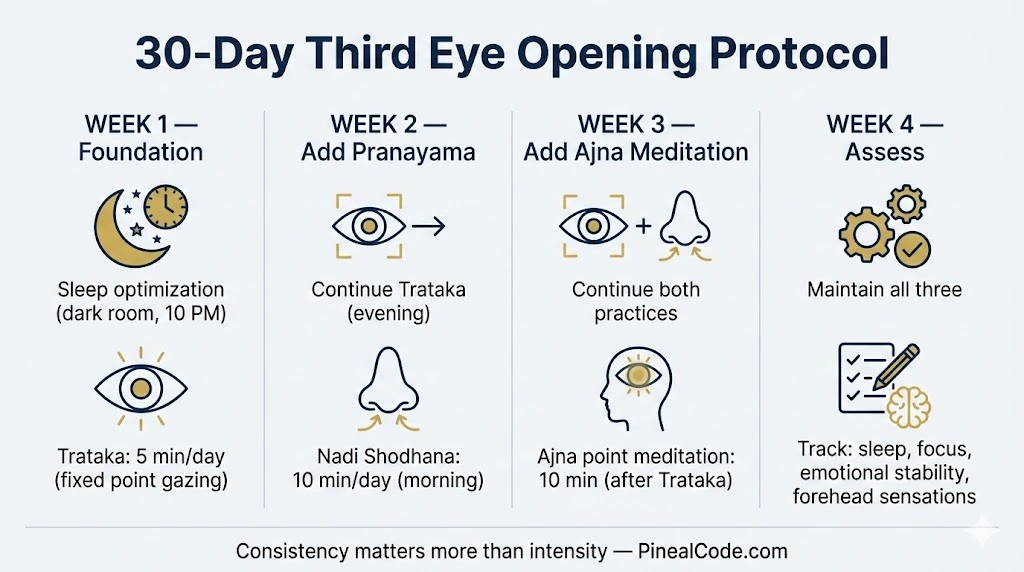
Sleep optimization only. Dark room, 10 PM bedtime minimum. Add Trataka: 5 minutes daily, fixed point at eye level. One practice. Your nervous system needs to adapt before you layer complexity.
Week 2: Add Pranayama
Continue Trataka. Add Nadi Shodhana: 10 minutes daily, mornings. Alternate nostril breathing, natural rhythm. Trataka in the evening, pranayama in the morning.
Week 3: Add Ajna Meditation
Continue both. Add Ajna point meditation: 10 minutes after Trataka when attention is already primed.
Week 4: Assess
Maintain all three. Track what you actually notice: sleep quality, daytime focus, emotional stability, sensations at the meditation point.
Honest expectation: structural brain changes require 8+ weeks. Altered states can occur earlier but aren’t guaranteed and aren’t the point. Measurable improvements in attention and nervous system stability by week 4 — that’s the realistic target.
What You’ll Actually Experience
The physical sensations come first.
Pressure between the eyebrows — described as “something pushing from inside.” Warmth. Visual phenomena with eyes closed: light, colors, geometric patterns. Pulsing or tingling in the forehead. These are real neurological phenomena linked to increased blood flow, neural activity, and heightened sensory perception. They often linger after practice, which many practitioners misinterpret as “the third eye staying open.” What’s actually happening is elevated interoceptive sensitivity that takes time to return to baseline. Normal. Expected.
Then the cognitive changes. Improved focus by week 3–4 — measurable, not imagined. Emotional volatility decreases. Sleep deepens. Morning clarity sharpens in a way that’s hard to attribute to anything else once it’s consistent. If you experience the pressure sensation frequently, the third eye pressure guide breaks down exactly what’s happening mechanistically.
What NOT to expect: psychic abilities, remote viewing, spontaneous DMT experiences.
If you’re expecting to suddenly see through walls, you’ll be disappointed. If you’re expecting to think more clearly and sleep better — the research is entirely on your side. Those outcomes are boring to market. They’re real enough to change how your days feel.
That’s the honest version. It’s also the only version that works.
Neuroscience
What Actually Changes in Your Brain
Timeline based on peer-reviewed neuroplasticity research
Weeks 1–2 · Foundation
😴
Sleep ArchitectureBegins improving
🔍
Trataka Focus TrainingNeural circuits activating
🌬️
Olfactory EntrainmentPranayama calibrating PFC
Research
Slow nasal breathing at 2.5 cycles/min produces measurable EEG deceleration in the prefrontal cortex from the first sessions — shifting the brain toward delta-theta oscillations.
PMC8977447 · 2022
What you'll notice
Mild pressure or warmth between the eyebrows during practice
Slightly deeper sleep on nights after practice
Mental restlessness — this is normal and temporary
Weeks 3–4 · Attention
🧠
Selective AttentionMeasurably improved
💆
Emotional RegulationVolatility decreasing
⚡️
Cognitive FlexibilityTrataka RCT effects visible
Research
Small-scale RCTs show Trataka practitioners improve cognitive flexibility and visual attention span within 4–6 weeks. The lateral prefrontal cortex and anterior cingulate strengthen their attentional control circuits.
What you'll notice
Improved focus that's measurable, not imagined
Sensations at the Ajna point linger after practice
Morning clarity sharpens noticeably
Week 8+ · Structural Changes
🔬
Prefrontal Cortex VolumeStructural enlargement
🔗
PFC Network IntegrationSignificantly increased
📈
Pineal Metabolic ActivityEnhanced MRI signal
Harvard · Mass General
Documented enlargement of the ventromedial prefrontal cortex and inferior frontal sulcus after standardized meditation training. Meditators show increased integration in PFC decision-making and emotional regulation networks vs. controls.
PMC7058252 · 2018 | PMC10026337 · 2023
What you'll notice
Sleep is consistently deeper and more restorative
Emotional responses become proportionate, not reactive
A quiet mental baseline that wasn't there before
Month 6+ · Deep States
🧘
Stable Altered StatesAccessible during practice
🎯
PFC–Thalamic CoherenceHigh integration
✅
Noetic Quality (William James)Feeling of knowing
Harvard · 2024
Altered states through yoga, meditation, and breathwork are far more common than previously thought — occurring in people with no special training, just consistent practice. Consistency matters more than intensity.
What you'll notice
Altered states during practice are stable, not random
Clarity that affects how your entire day feels
The practice becomes self-reinforcing — you want to sit
⚠️ Timeline based on neuroplasticity research. Individual results vary. Structural changes require consistent daily practice. Not a medical claim.
Frequently Asked Questions
What does it feel like when your third eye opens?
Not a single event — it's progressive development of attention and interoceptive awareness at the Ajna point. Practitioners report pressure between the eyebrows, visual phenomena with eyes closed, expanded mental space, and shifts in perception. Neurologically, this corresponds to heightened activity in prefrontal and thalamic regions. The experience is real. The opening is gradual, not sudden.
How long does it take to open your third eye?
Noticeable sensations at the Ajna point: 2–4 weeks of daily practice. Measurable attention improvements: 4–8 weeks. Structural brain changes in the prefrontal cortex: 8+ weeks minimum. Stable altered states during practice: 6–12 months of consistent work. Consistency matters more than intensity.
Is opening your third eye dangerous?
Not with these practices. Trataka, pranayama, and focused meditation have well-documented safety profiles across centuries of use. Some people experience mild pressure sensations or temporary perception shifts — entirely benign. Certain extreme pranayama techniques require caution. If you have a history of dissociative experiences or psychiatric conditions, consult a healthcare provider first.
What is the third eye and where is it located?
In Tantric tradition: the Ajna chakra, located between the eyebrows at the level of the pineal gland and thalamus. Anatomically, it corresponds to the prefrontal cortex and its connectivity with the thalamus and sensory integration networks. The pineal gland is part of this system — but the functional third eye is a broader neural network, not a single gland.
Can you open your third eye through meditation alone?
Yes. Pure focused meditation on the Ajna point develops the necessary attention and interoceptive awareness. It typically requires longer daily sessions (45–60 minutes vs. 25–30 minutes for the combined protocol). Adding Trataka accelerates the process. Meditation alone works — it just takes more time.
How do I know if my third eye is blocked?
Common indicators: scattered thinking, poor emotional regulation, difficulty maintaining attention, reduced dream recall, and persistent mental fog despite adequate sleep. These correspond neurologically to reduced prefrontal activation and poor thalamic gating. Blocked is less useful than underdeveloped — the capacity exists in every brain. It just needs training.
Does the pineal gland really have anything to do with the third eye?
Partially. The pineal produces melatonin and shows altered metabolic activity in advanced meditators. But the functional third eye involves the broader prefrontal cortex, thalamic relay, and interoceptive networks — not just the pineal. The pineal is part of the system. Traditions identified this role without knowing the biochemistry, which is why the anatomy aligns with experience even in 15th-century texts.
Marcus Hale is an independent researcher and former clinical neuroscientist. The content on PinealCode.com is for informational purposes only and does not constitute medical advice.
Medical Disclaimer: The content on
PinealCode.com is for informational and educational purposes only. Nothing here
constitutes medical advice, diagnosis, or treatment. Always consult a qualified
healthcare provider before making changes to your health regimen.
Affiliate Disclosure: This article
contains affiliate links. Purchasing through these links may earn us a commission
at no extra cost to you.
Marcus Hale
Independent Researcher · Former Clinical Neuroscientist
I spent 12 years in clinical neurology before the questions got more interesting
than the answers. PinealCode is where I document what I find at the intersection
of brain science and consciousness.