7 min read
Is PinealPure a Scam? 39 RCTs Later, Here's the Real Verdict
Pycnogenol® backed by 39 RCTs. Bacopa by 9. But the 'pineal detox' claims? Zero human trials. Full ingredient breakdown and honest verdict...
April 16, 2026
Read →

Here’s a scenario I recognize: you’ve been sleeping badly, feeling mentally dull, maybe drifting toward something that might loosely be called a spiritual search — and you land on a supplement that promises to “activate your third eye,” let you “manifest abundance,” and restore a gland buried deep in the center of your brain. The supplement is Awaken XT. The price is around $49. The claims are large.
I spent 12 years as a clinical neuroscience researcher before my own experience forced me to stop dismissing what I couldn’t measure. So I’m exactly the wrong person to sell you easy answers on this — and exactly the right person to cut through the noise. I pulled every published study on Awaken XT’s ingredients, cross-checked the gaps, and read what real users actually report. What I found is more complicated than “scam” or “miracle.” Let me show you.
Quick Verdict — Awaken XT

A legitimate adaptogen stack sold with spiritual activation claims it can't support. Schisandra, Mucuna, and Amla have real adaptogenic evidence. The 365-day guarantee makes it a low-risk trial for stress and sleep support — not third eye activation.

Awaken XT is a daily oral supplement — capsules, two per day — marketed primarily around pineal gland support, detoxification, and what the product page calls “third eye activation.” The product moves through MaxWeb affiliate networks at approximately $49 per bottle, with bundle pricing pushing the per-bottle cost down to around $29 in some campaigns.
Manufactured in an FDA-registered, GMP-certified facility — and that distinction deserves precision: that registration covers quality control processes (cleanliness, labeling, consistency), not an FDA evaluation of the product’s claims. That gap matters enormously when you’re assessing what “pineal gland activation” actually means in a regulatory context.
The core formula contains nine botanical ingredients: Chaga Mushroom, Chlorella, Gymnema Sylvestre, Turmeric/Curcumin, Inositol, Amla Fruit, Schisandra Berry, Mucuna Pruriens, and Cat’s Claw. Doses for each are not publicly disclosed — proprietary blend territory, which is a real limitation when trying to assess whether any ingredient is present at a clinically meaningful level.
The product comes with a 365-day money-back guarantee, which is genuinely unusual and worth noting positively. If you want to understand why the pineal gland even matters in this conversation, the background on pineal gland calcification symptoms gives useful context.
Let me be surgical here. I separated the nine ingredients into two categories: those with legitimate human clinical evidence (for something, even if not pineal function specifically), and those where the evidence is extrapolated, animal-only, or simply absent for any relevant outcome.
Turmeric / Curcumin has a real body of research behind its anti-inflammatory mechanisms — specifically reducing TNF-α, IL-1β, and microglial activation in neuroinflammation models. A 2025 review in Frontiers in Pharmacology documented these effects across multiple animal models of neurological disease. The critical problem is bioavailability: standard oral curcumin has roughly 1% absorption without piperine or liposomal formulation. If Awaken XT uses standard curcumin — which the label doesn’t clarify — you’re likely not absorbing enough to replicate what was studied.
Inositol has published clinical data in humans, primarily at 12–18 grams per day for mood disorders and PCOS via phosphatidylinositol signaling pathways. The gap: typical supplement capsules contain a fraction of that dose, and no published study connects inositol to pineal function at any dose.
Schisandra Berry has peer-reviewed evidence as an adaptogen — a review published in PMC documents its modulation of cortisol and the HPA axis stress response, including reduction of cortisol and nitric oxide under stress conditions. Indirect neurological support via stress modulation is plausible. Direct pineal evidence: zero.
Mucuna Pruriens is the most pharmacologically active ingredient in this formula. The most concentrated natural source of L-DOPA, with preclinical models suggesting dopaminergic antidepressant effects. That’s real. But a 2024 case report documented Dopamine Dysregulation Syndrome from supplemental Mucuna use in humans — precipitating episodes of agitation, psychosis, and dyskinesia — a real safety signal for anyone on dopaminergic medications.
Amla Fruit (Phyllanthus emblica) shows consistent antioxidant and anti-inflammatory effects in small human trials — LDL oxidation reduction, immune markers. High vitamin C content is well-documented.
Chaga Mushroom reversed scopolamine-induced amnesia in mice in a 2011 Phytomedicine study (PMID: 21779570) via acetylcholinesterase inhibition and oxidative stress reduction. No randomized controlled trials in humans. No pineal data of any kind.
Chlorella has small human studies on heavy metal chelation — lead and mercury reduction. The leap from “binds metals” to “decalcifies the pineal gland” is a marketing inference, not a documented mechanism. No peer-reviewed study confirms that Chlorella reduces pineal calcification in humans.
Gymnema Sylvestre has solid human clinical data — in diabetics, for glycemic control. The entire literature base covers blood sugar, not neurology, not melatonin, not the pineal gland.
Cat’s Claw (Uncaria tomentosa) showed inhibition of amyloid-beta plaques and tau tangles in vitro — a test-tube finding from 2019 that represents a long road from any clinical outcome, let alone third eye activation.
A 2023 meta-analysis (PMC9987140) found that 61.65% of adults show pineal calcification — but no published randomized controlled trial has tested any oral supplement’s ability to reverse it.

No — not in any scientifically verifiable sense, and that answer deserves more than a dismissal.
The pineal gland is a photoneuroendocrine organ. Its primary confirmed function is rhythmic melatonin synthesis driven by the light-dark cycle, mediated by norepinephrine via cAMP/PKA signaling. Calcification is prevalent — the meta-analysis above found it in nearly 62% of adults — and it correlates with reduced melatonin production and potentially elevated neurodegeneration risk. That’s real biology worth caring about.
What’s not real, in any peer-reviewed framework, is the claim that oral botanical supplementation “activates” this gland or opens a “third eye.” No randomized clinical trial has tested any combination of adaptogens for pineal activation. “Third eye activation” is not a recognized clinical endpoint by the FDA, EMA, or any research institution. No validated biomarker, no imaging protocol, no measurement instrument exists for this outcome. That’s not a gap in my knowledge — it’s a gap in the science itself.
What I can say more fairly: the adaptogenic ingredients in this formula — Schisandra, Mucuna, Amla, Cat’s Claw — have biological plausibility for general systemic support: stress modulation, oxidative protection, indirect neuroprotective effects via HSP70 and neuropeptide Y expression. That’s a legitimate, if modest, category of benefit. It’s just not what the marketing is selling you. Learn more about the actual biology of pineal health at how to decalcify the pineal gland naturally.

The user sentiment pattern for Awaken XT is more consistent than I expected — but it tells a different story than the marketing.
The most common positive reports cluster around improved sleep quality and a diffuse sense of “mental clarity” in the first two to four weeks. Users in spiritually-oriented communities (r/spirituality, r/meditation) frequently describe more vivid dreams and more focused meditation sessions. These are the buyers most aligned with the product’s target audience, and some report genuine satisfaction.
The negative pattern is equally consistent: inconsistent results across users, with a meaningful percentage reporting no change after 60–90 days. The complaint that surfaces most often is the expectation gap — buyers who came for “third eye activation” and “manifestation of abundance” report that what they actually experienced, if anything, resembles a mild adaptogenic effect on stress and sleep.
One methodological note worth flagging: a significant portion of Reddit threads reviewed for this article showed signs of affiliate-generated content — particularly on r/EnlightenedSoul and r/Reviews. Organic reviews on r/Supplements and r/nootropics are sparse for this specific product, which makes independent validation harder than it should be.
Here’s where I land after reviewing all the available data: Awaken XT is a modestly legitimate adaptogen supplement being sold with illegitimate claims.
The ingredients aren’t fake. Chaga, Schisandra, Amla, Cat’s Claw — these are real botanicals with real (if limited) research profiles. Some users experience genuine improvements in sleep quality and stress resilience, consistent with what we know about adaptogenic compounds. That’s not nothing.
But “activating the third eye,” “decalcifying the pineal gland,” and “manifesting abundance” are not outcomes this product can deliver — not because the ingredients are fraudulent, but because those claims have no scientific framework, no measurable endpoint, and no clinical evidence connecting them to any ingredient in the formula. Not in humans. Not in these doses. Not in this combination.
If you’re buying a stress-support adaptogen blend and you accept that framing, Awaken XT might be worth a trial — especially with the 365-day guarantee removing most of the financial risk. If you’re buying a spiritual activation device, you’re paying $49 for a story.
For comparison, see my analysis of similar products: Pineal Guardian review and Pineal XT review.

Marcus's Verdict
Awaken XT
A legitimate adaptogen formula wearing pineal marketing. The 365-day guarantee makes it a low-risk trial if you're curious — but calibrate expectations to stress support and sleep quality, not spiritual activation.
Affiliate disclosure: we may earn a commission at no extra cost to you.
Awaken XT is sold exclusively through its official website and affiliated channels — not available on Amazon or in retail stores. The standard price sits at approximately $49 per bottle (one-month supply), with bundle discounts reducing the per-bottle cost to roughly $29 when purchasing three or six bottles at once.
The 365-day money-back guarantee is the standout commercial feature — a full year to decide, significantly more than the industry standard 30–60 days. It reduces the real financial risk of trying the product.
If you decide to try it, purchase through Awaken XT’s official channel to ensure you’re getting the guarantee and the authentic product — third-party listings cannot be verified and won’t honor the refund policy.
Disclosure: This article contains affiliate links. If you purchase through these links, I may earn a commission at no extra cost to you.
Marcus Hale is an independent researcher and former clinical neuroscientist. Nothing here constitutes medical advice.
Pycnogenol® backed by 39 RCTs. Bacopa by 9. But the 'pineal detox' claims? Zero human trials. Full ingredient breakdown and honest verdict...
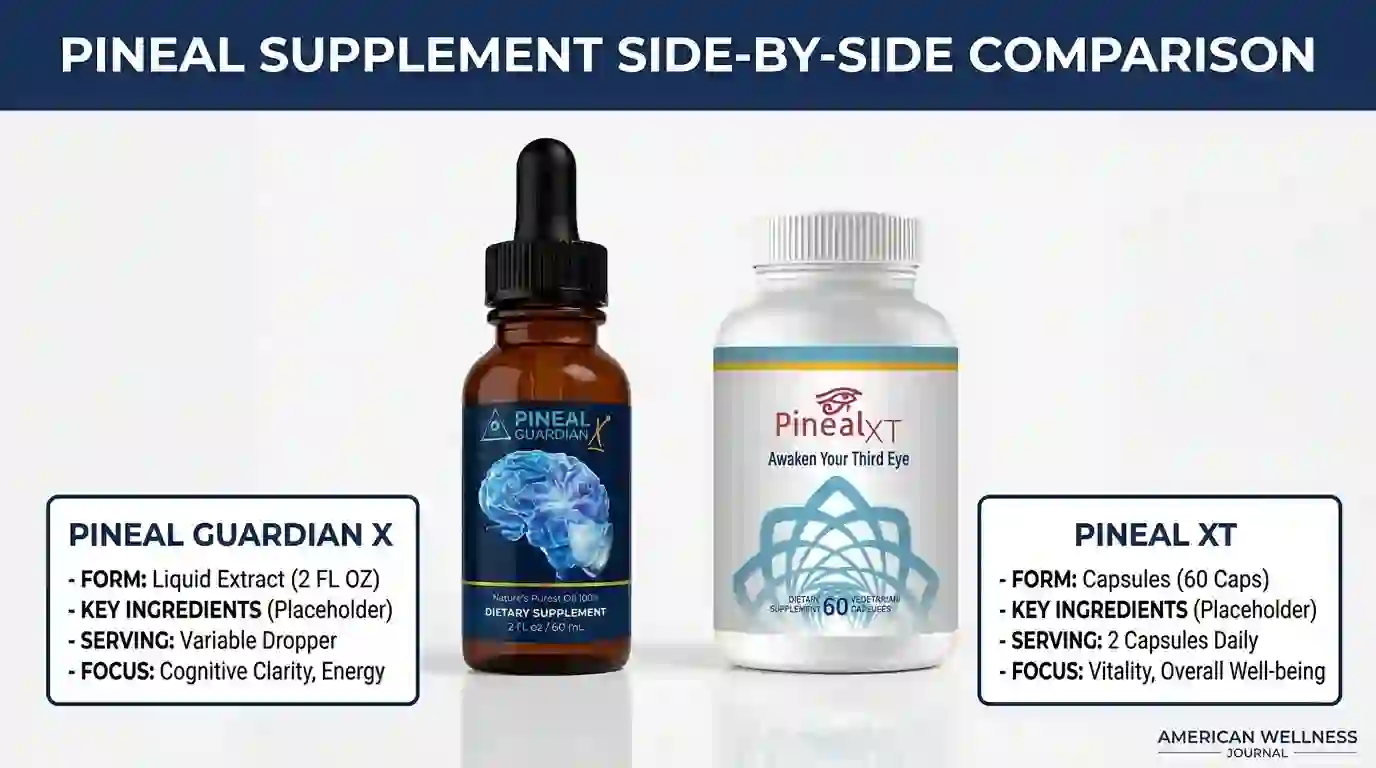
Pineal Guardian wins on evidence quality (39 RCTs behind Pine Bark). Pineal XT targets fluoride via iodine. Full ingredient breakdown and...

9 botanicals, 7 with documented mechanisms — but Lion's Mane needs 3,000 mg/day. Full Pineal Guardian ingredient analysis: what works,...

Marcus Hale
Independent Researcher · Former Clinical Neuroscientist
I spent 12 years in clinical neurology before the questions got more interesting than the answers. PinealCode is where I document what I find at the intersection of brain science and consciousness.