There are over 14 million YouTube videos promising that solfeggio frequencies will “activate your pineal gland.” Play 963 Hz while you sleep. Listen to 528 Hz and repair your DNA. Open your third eye with sound alone.
I spent twelve years in clinical neuroscience. I’ve also sat in dark rooms with headphones at 3 AM, feeling something I couldn’t explain with a p-value. So I went looking for what the research actually says about solfeggio frequencies and the pineal gland. The peer-reviewed kind. Not the kind with a Tibetan singing bowl thumbnail and a comment section full of people claiming they saw God on night two.
What I found was more interesting than either side wants to admit.
The mechanism is real. The specific claims are not. And the distance between those two facts is where this whole conversation falls apart.
What Are Solfeggio Frequencies?
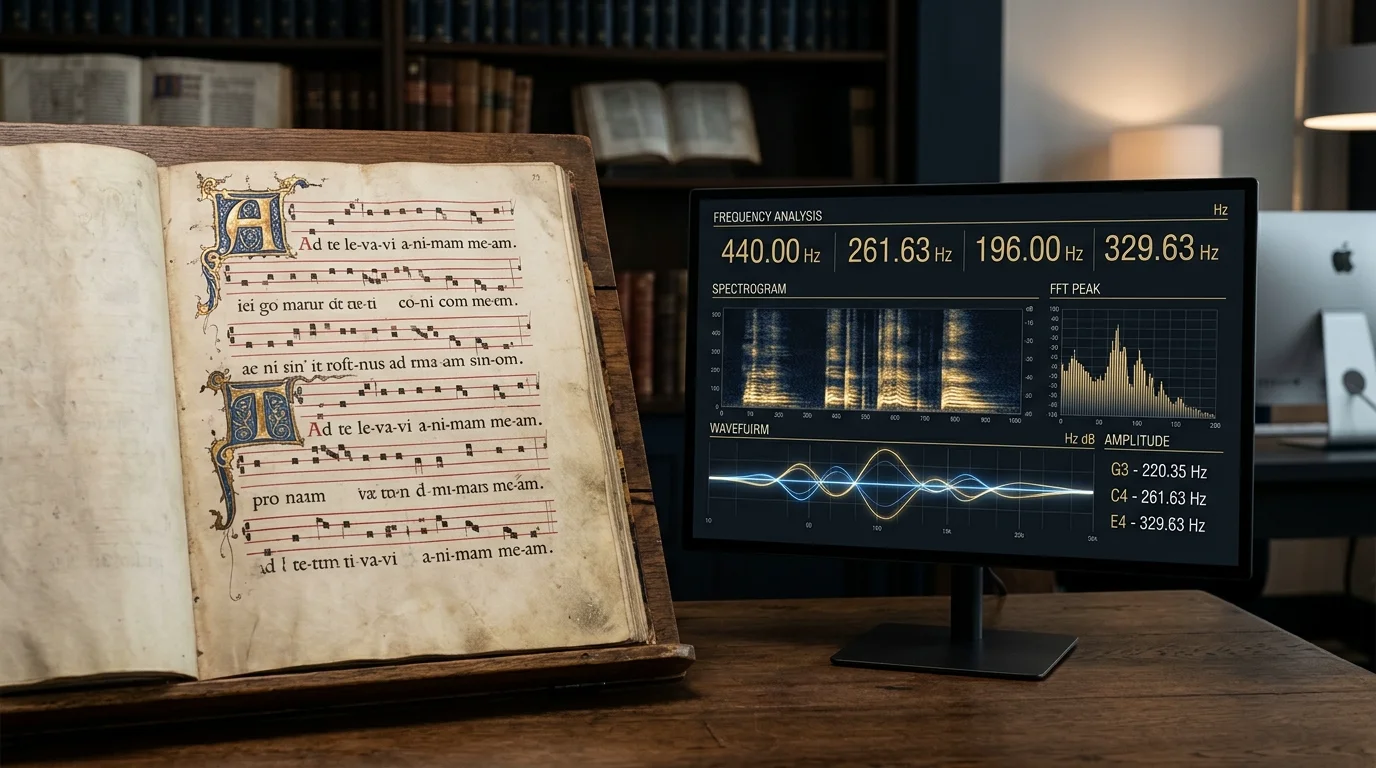
The original solfeggio scale comes from an 11th-century Benedictine monk named Guido d’Arezzo. He built a six-note system — Ut, Re, Mi, Fa, Sol, La — from a hymn to St. John the Baptist. That part is documented. You can look it up in any music history textbook.
The modern part is a different story.
In the 1990s, Dr. Joseph Puleo claimed he’d rediscovered a set of ancient frequencies hidden in the Book of Numbers using numerological patterns. Dr. Leonard Horowitz ran with it, popularizing 528 Hz as the “love frequency” in his book Healing Codes for the Biological Apocalypse. The full modern set: 396, 417, 528, 639, 741, 852, and 963 Hz. Some practitioners tack on 174 and 285 Hz for good measure.
These modern frequencies have no verified connection to the medieval system. The names are borrowed. The math is new. That doesn’t make them useless by default, but the “ancient wisdom” framing is marketing. Not history.
The original solfeggio system (11th century, Guido d’Arezzo) has no documented connection to the modern Hz frequencies marketed today — the names are borrowed, the math is new.
What Solfeggio Frequency Is Best for the Pineal Gland?
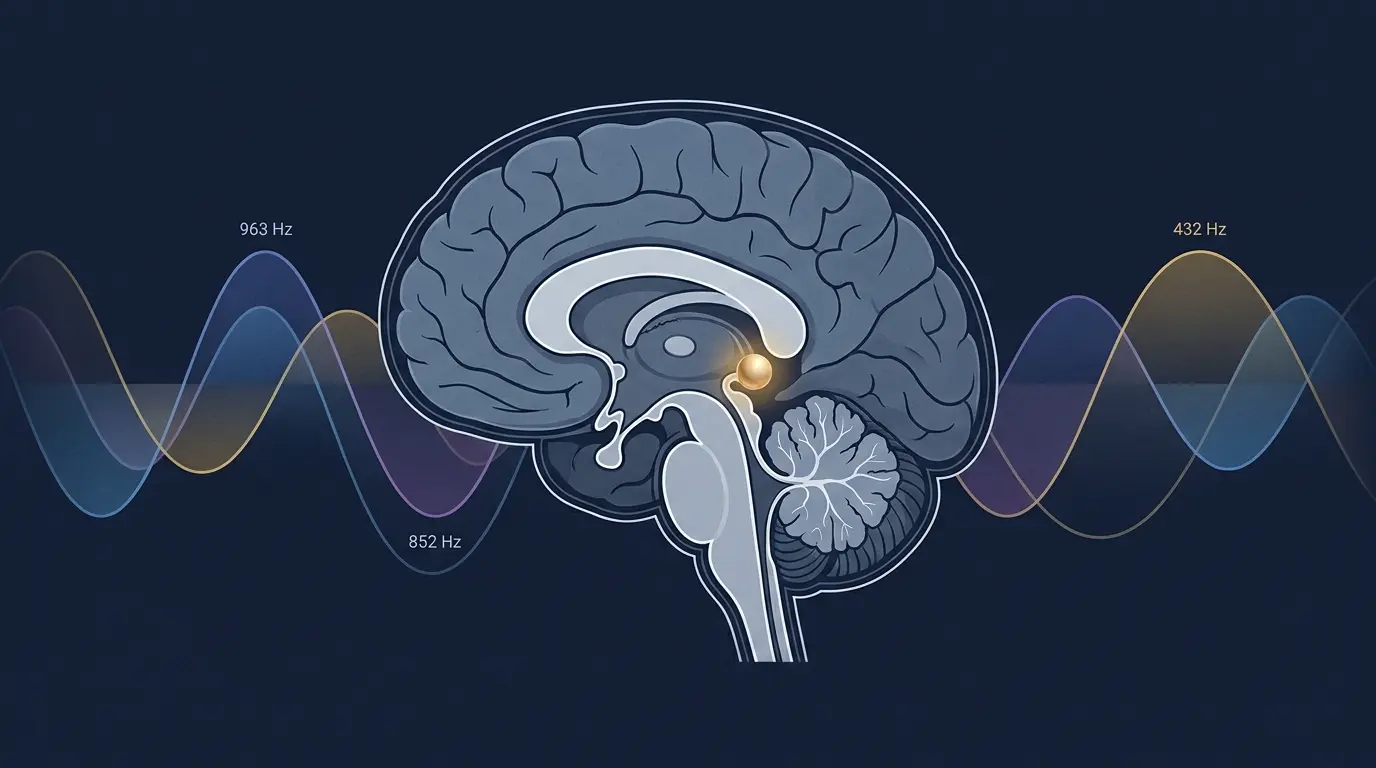
852 Hz and 963 Hz are the two most commonly cited for pineal gland activation. Neither has been tested on pineal tissue in any peer-reviewed study.
963 Hz gets called the “frequency of the gods” in spiritual circles — I’ve covered what the science actually says about it here. 852 Hz is positioned as the “third eye frequency,” and I’ve written about it separately here.
But here’s what nobody selling you a playlist mentions: the number on the label isn’t what reaches your brain. Not in the way that matters.
When these frequencies arrive as binaural beats through headphones, your brain responds to the difference between the left and right channels. Not the carrier. A 963 Hz tone in one ear and 957 Hz in the other produces a 6 Hz binaural beat. Theta range.
That theta beat is where the science lives. The 963 on the label is just the delivery truck.
Does 528 Hz Activate the Pineal Gland?
No. Not based on any direct evidence that exists right now. No peer-reviewed study has tested 528 Hz on pineal gland function or melatonin production in humans.
What does exist: a 2018 study by Akimoto et al. in Health found that 528 Hz music reduced cortisol and increased oxytocin compared to 440 Hz tuning after five minutes of exposure. A 2019 study in Genes and Genomics showed 528 Hz sound waves at 100 dB changed testosterone production and reduced reactive oxygen species in rat brain tissue.
Real studies. Published. Peer-reviewed.
Neither one measured anything happening in the pineal gland.
Zero peer-reviewed studies have directly tested the effect of 528 Hz — or any solfeggio frequency — on pineal gland function or melatonin production in the pineal gland in humans.
The “miracle tone” label comes from Horowitz, not from a lab. Could 528 Hz affect the pineal? It’s not impossible. But “not impossible” and “proven” are separated by about a decade of research that nobody has bothered to fund. I used to think that absence of evidence meant the idea was probably wrong. After enough time in this field, I’ve learned it sometimes just means nobody with grant money cared enough to check.
How Solfeggio Frequencies Affect the Brain
Here’s what’s actually happening when you put on headphones and press play.
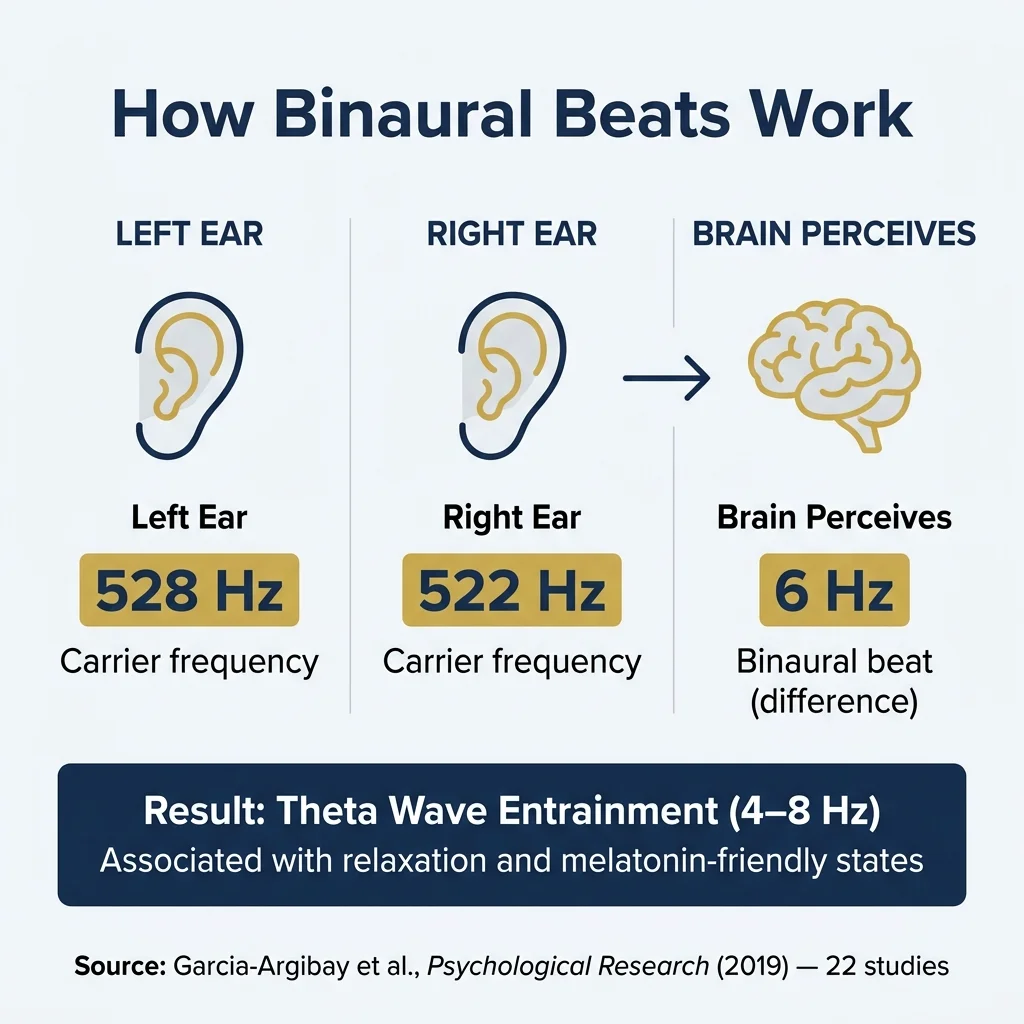
Your ears receive two slightly different frequencies, one per channel. Your brainstem detects the mismatch and generates a third perceived tone: the binaural beat. Left ear gets 528 Hz, right ear gets 522 Hz, your auditory cortex processes a 6 Hz beat. Theta range. This is where things get relevant for the pineal gland.
A 2019 meta-analysis by Garcia-Argibay and colleagues in Psychological Research covered 22 studies and found a medium effect size (g = 0.45) of binaural beats on cognition, anxiety, and pain perception. Longer sessions worked better. Timing mattered.
A 2022 pilot study by Dabiri et al. found that delta-range binaural beats (3 Hz) improved sleep quality and reduced anxiety in students. Small sample. Twenty people. But the direction was consistent.
And a 1992 paper by Sandyk in the International Journal of Neuroscience proposed something I keep coming back to: a bidirectional relationship between brainwave rhythms and pineal melatonin. Brainwave states don’t just reflect what the pineal is doing. They may push it in a direction.
The carrier frequency — 528, 440, 963 — is the vehicle. The binaural beat is the driver. No study has isolated whether the carrier adds anything on its own. That gap bothers me more than most, because it’s the one question the entire solfeggio community is built on, and nobody has run the experiment.
How binaural beats work: left ear receives 528 Hz, right ear 522 Hz — the brain perceives the 6 Hz difference as a theta wave. The carrier frequency on the label is irrelevant to this mechanism.
For more on which frequencies may stimulate the pineal gland, see this breakdown.
Is There Scientific Evidence for Solfeggio Frequencies?
Limited. And almost none of it tests what people actually claim.
The evidence splits into two buckets. First: studies showing that 528 Hz produces measurable biological effects in cells and animals. Akimoto 2018. Babayi Daylari 2019. Bhoot et al. 2025 showed OM chanting at 528 Hz improved heart rate variability and sleep quality in hypertensive patients over one month. That last one is interesting, but it combined 528 Hz with the physical act of chanting, so good luck separating the variables.
Second: studies on binaural beat entrainment showing that auditory stimulation can shift brainwave patterns toward theta and delta states linked to relaxation and sleep. A systematic review of binaural beat stimulation on brain oscillatory activity found that results remain inconsistent across studies — with only five of fourteen studies fully supporting the entrainment hypothesis.
What’s missing is the bridge.
Nobody has published a controlled study measuring melatonin before and after solfeggio-based binaural beats. Nobody has compared 528 Hz as a carrier against 440 Hz with the same beat difference. Nobody has put someone in an fMRI and watched what 963 Hz does to pineal activity.
The mechanism — entrainment — is supported. The specific claim — that this frequency has special power over that gland — is not. I realize that’s an unsatisfying answer. It’s also the honest one.
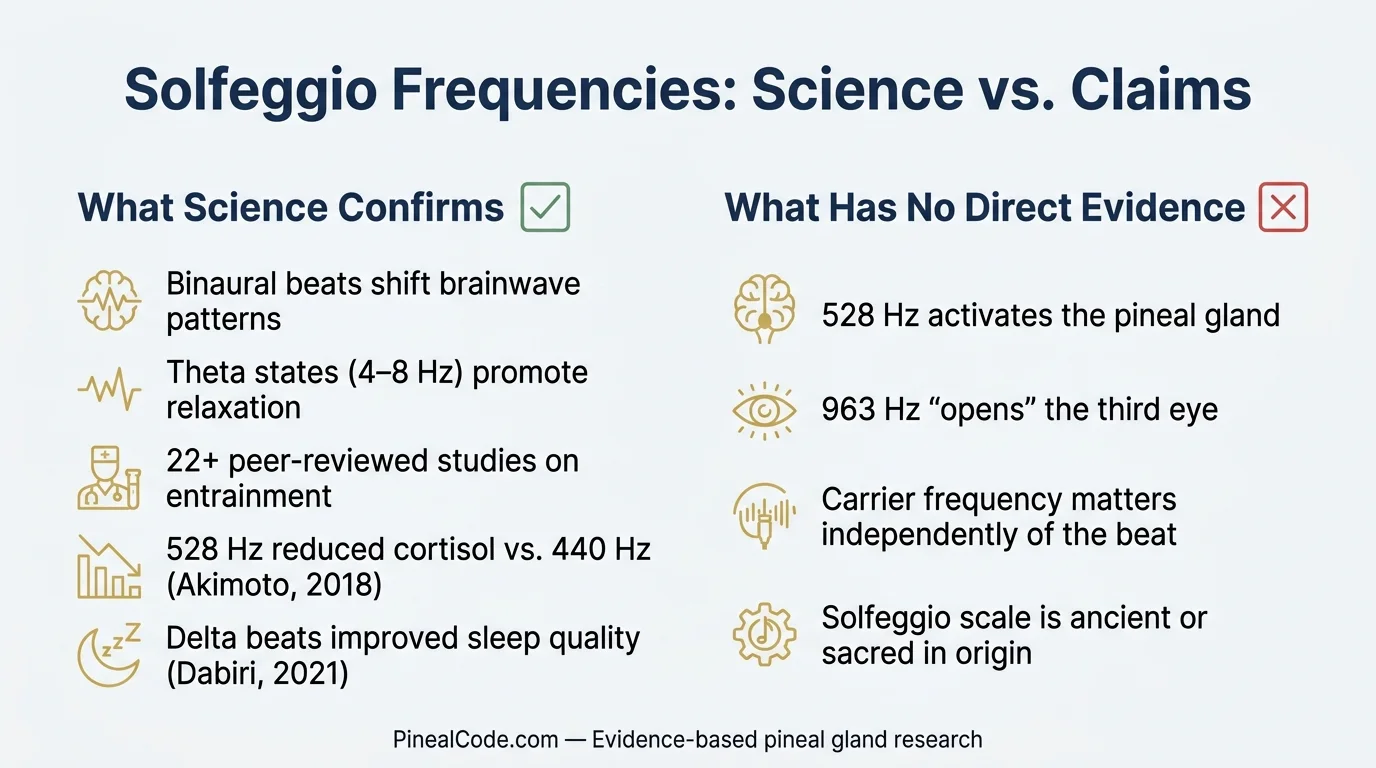
What peer-reviewed research confirms (binaural entrainment, theta shifts) versus what remains unverified (carrier frequency effects, pineal-specific activation). The gap between the two is where most solfeggio content lives.
How to Use Solfeggio Frequencies for Pineal Health
If you want to try this — and I think there’s enough indirect evidence to make it reasonable — here’s a protocol based on what we actually know. Not what sounds good on a podcast.
Use Stereo Headphones
Non-negotiable. Binaural beats need channel separation. Left ear gets one frequency, right ear gets another. Speakers blend the signal and you lose the beat entirely. Over-ear headphones work best. Earbuds are fine.
Listen 20–40 Minutes Before Sleep
Melatonin production peaks in darkness during the early sleep window. Theta entrainment during this period lines up with the body’s own rhythm. Listening at 2 PM on your lunch break is not the same thing. The Garcia-Argibay meta-analysis confirmed that timing changes outcomes. For a deeper look at why nighttime matters for pineal function, see this guide on pineal gland decalcification at night.
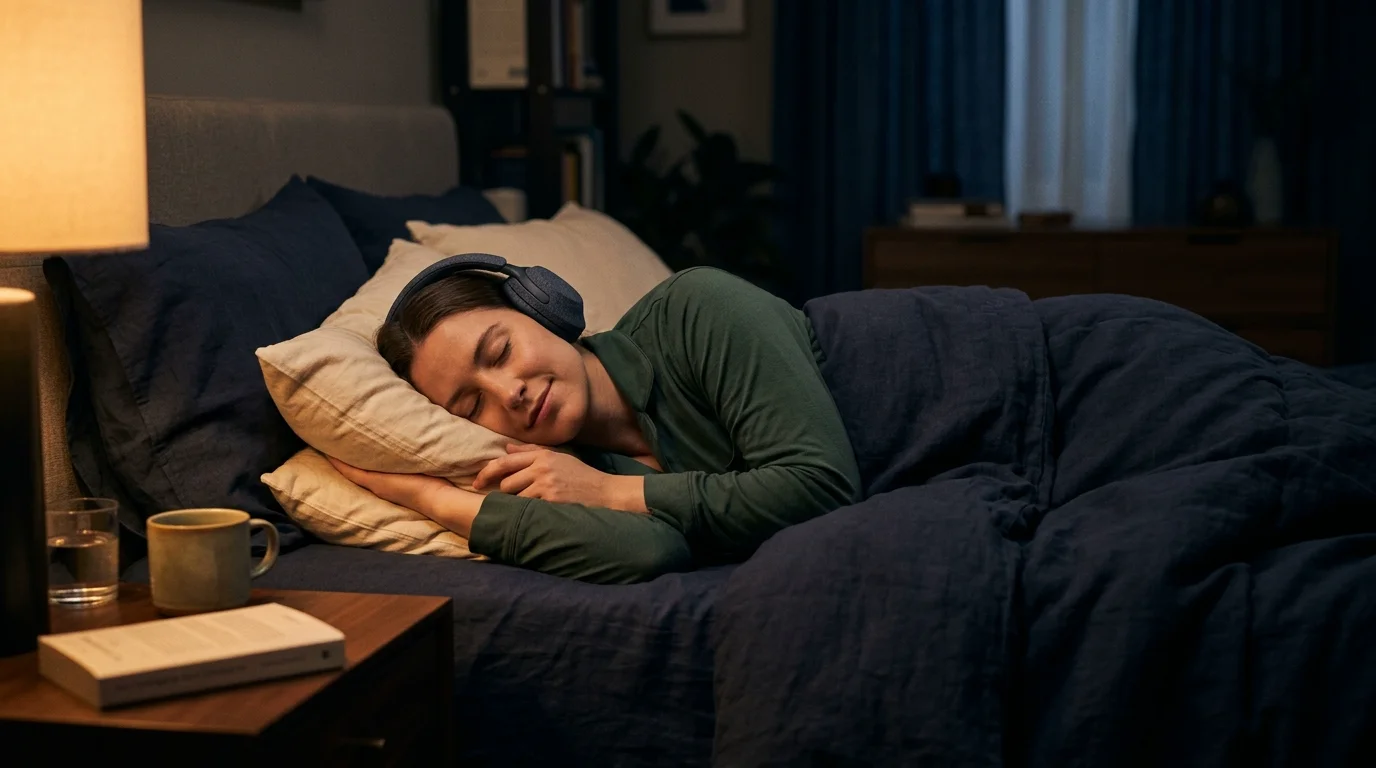
Optimal protocol: headphones, darkness, no screens, 20–40 minutes before sleep. The timing aligns theta entrainment with the body’s natural melatonin window.
Combine With Darkness and No Screens
This is the part people skip, and it’s like taking melatonin with a cup of coffee. Blue light suppresses melatonin at the receptor level. Kill the screens thirty minutes before you start. Dim the lights. Let darkness do its half of the work.
Set Realistic Expectations
You’ll probably feel relaxed. You may fall asleep faster. Some people report vivid dreams.
What you won’t experience is your pineal gland flipping on like a light switch. That’s not how glands work. That’s not how sound works. If someone promises otherwise, they’re selling something. (There’s always someone selling something.)
If you’re looking for additional pineal support beyond sound, I’ve reviewed Pineal Guardian here. I’d start with the free stuff first.
What This Means for You
The solfeggio frequencies and pineal gland connection is real. Just not in the way most people describe it.
Binaural beat entrainment works. Theta states correlate with conditions favorable to melatonin production. Sound can shift your brainwaves. These are documented findings from real journals.
But the idea that 963 Hz targets your pineal gland specifically, or that 528 Hz “activates” it like a tuning fork hitting crystal — that’s speculation wearing a lab coat. The carrier frequency hasn’t been shown to matter independently of the beat it produces. The one physical finding that actually connects crystals and the pineal gland — calcite microcrystals confirmed by four independent methods in 2002 — has nothing to do with audio frequencies. That science is real and worth understanding on its own terms.
Use solfeggio tracks as a tool. Pair them with darkness, stillness, and decent sleep habits. Expect relaxation, not revelation.
And if someone tells you a YouTube video can open your third eye, ask them for the DOI number.
The informed approach: use solfeggio tracks as a relaxation tool, pair with evidence-based sleep hygiene, and demand DOI numbers before accepting extraordinary claims.
Frequently Asked Questions
What solfeggio frequency is good for the pineal gland?
852 Hz and 963 Hz are most associated with pineal gland activation in the solfeggio system. However, no peer-reviewed study has confirmed direct effects on pineal tissue from these specific frequencies.
Does 528 Hz activate the pineal gland?
Not directly. One 2018 study showed 528 Hz affected immune cells in vitro, but no study has tested its effect on pineal gland function or melatonin production specifically.
Is there scientific evidence for solfeggio frequencies?
Limited. The best-supported mechanism is binaural beat entrainment into theta waves (4–8 Hz), which correlates with melatonin production — not the carrier frequency itself.
How do solfeggio frequencies affect the brain?
When delivered as binaural beats via headphones, the difference between channels creates brainwave entrainment. Theta and delta entrainment are linked to relaxation and melatonin release.
What frequency opens the third eye?
No frequency 'opens' the third eye in a literal sense. Theta waves (4–8 Hz) from binaural entrainment correlate with meditative states associated with third eye awareness in spiritual practice.
Marcus Hale is an independent researcher and former clinical neuroscientist. The content on PinealCode.com is for informational purposes only and does not constitute medical advice.
Medical Disclaimer: The content on
PinealCode.com is for informational and educational purposes only. Nothing here
constitutes medical advice, diagnosis, or treatment. Always consult a qualified
healthcare provider before making changes to your health regimen.
Marcus Hale
Independent Researcher · Former Clinical Neuroscientist
I spent 12 years in clinical neurology before the questions got more interesting
than the answers. PinealCode is where I document what I find at the intersection
of brain science and consciousness.