Pineal Gland Activation Frequency: What 963 Hz, 852 Hz and 432 Hz Actually Do
By Marcus Hale·
Pineal Gland Activation Frequency: What Each Hz Actually Does
Everyone in the meditation space has an opinion on which pineal gland activation frequency works best. Most of those opinions are marketing dressed as biology.
Here’s what’s actually interesting: your pineal gland contains calcite microcrystals. They’re the only non-pathological calcite crystals in the human body, besides the ones in your inner ear. A 2002 study published in Bioelectromagnetics confirmed these crystals have a molecular structure compatible with piezoelectricity: they can, in principle, convert acoustic vibration into electrical signals. That’s the biological link between sound and your pineal gland. That’s what nobody bothers explaining while they sell you 963 Hz loops.
The problem is the gap between structure and function. No study has demonstrated that external frequencies activate those crystals under actual listening conditions: headphones, safe volume, living human. Those are different things, and conflating them is how an interesting hypothesis becomes a $29.99 sleep track.
This is a comparative guide. Every major pineal activation frequency (963 Hz, 852 Hz, 432 Hz, 528 Hz, and binaural beats) mapped against what each one claims and what the published evidence actually supports. For the full biological background, read the piezoelectric mechanism behind this.
How Sound Frequencies May Affect the Pineal Gland
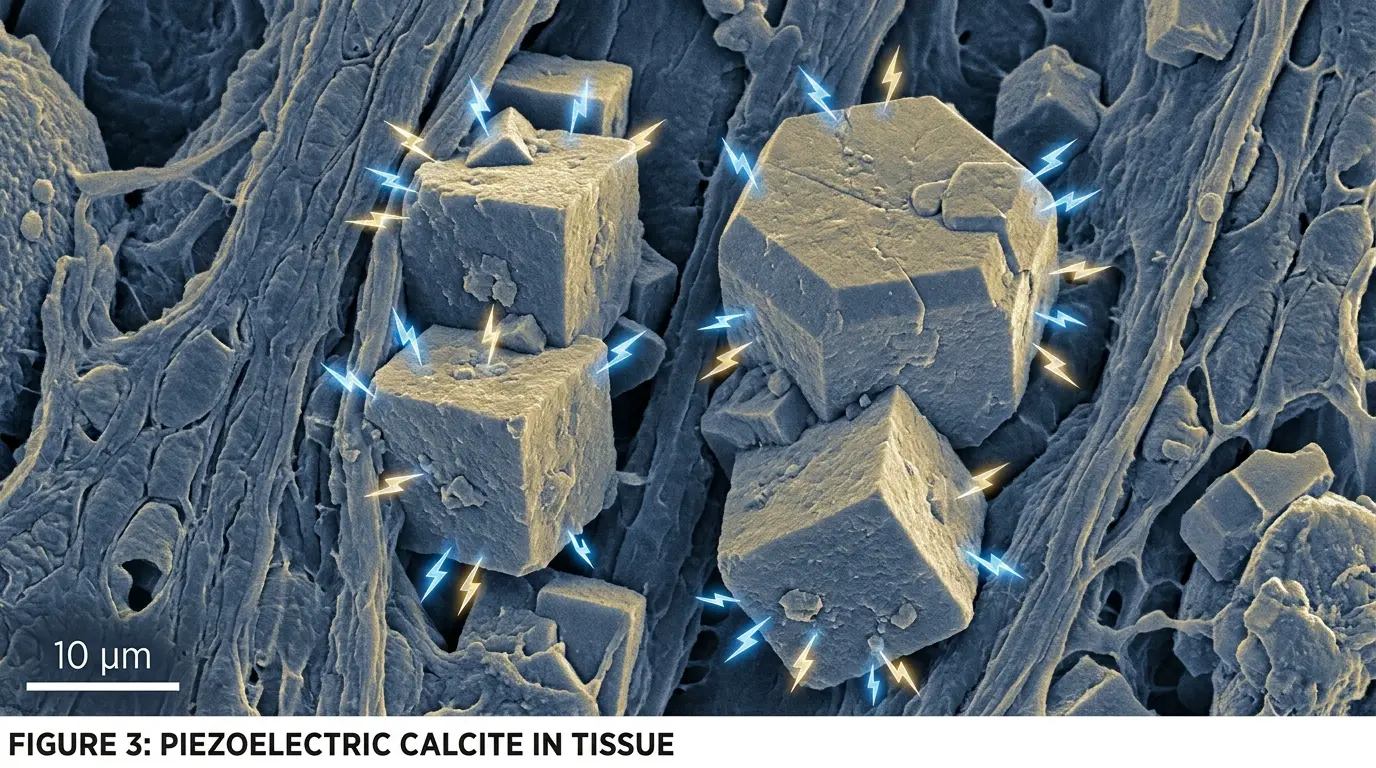
The calcite microcrystals Baconnier’s team identified measure less than 20 micrometers and appear in cubic, hexagonal, and cylindrical forms. Under scanning electron microscopy and Raman spectroscopy, they showed second harmonic generation, the crystallographic signature of a structure capable of piezoelectric activity. When you vibrate a piezoelectric crystal, it generates a small electrical charge. In theory, acoustic vibration reaching the pineal gland could trigger exactly that kind of cellular signaling.
In theory.
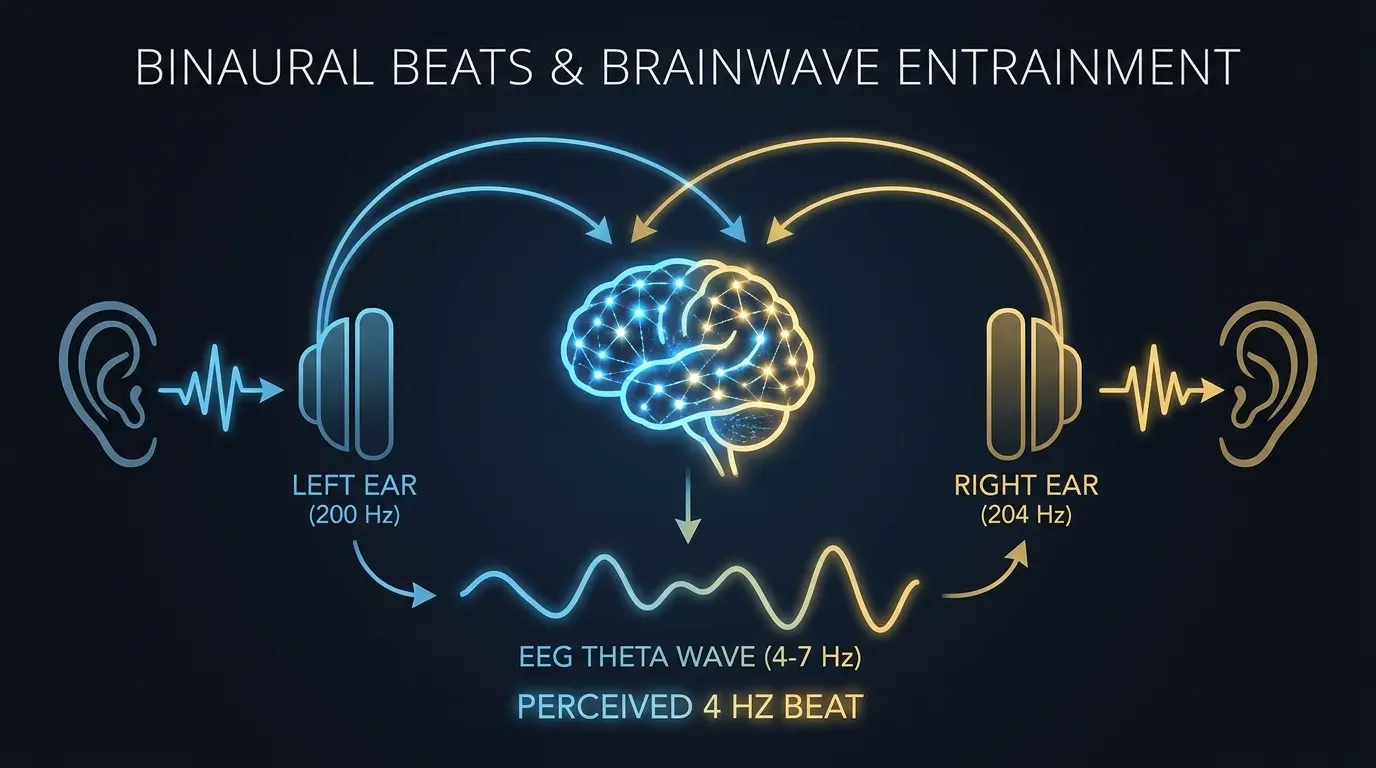
The second mechanism is less direct but better documented: brainwave entrainment. Present two slightly different tones, one per ear (say 200 Hz left, 204 Hz right), and your brain perceives a third tone at the 4 Hz difference. That’s a binaural beat. Neural oscillations tend to synchronize toward that perceived frequency, pushing the brain into theta (4–8 Hz) or delta (0.5–4 Hz) states. Measurable on EEG. Whether the downstream effect reaches pineal function specifically is where the inference chain starts getting long.
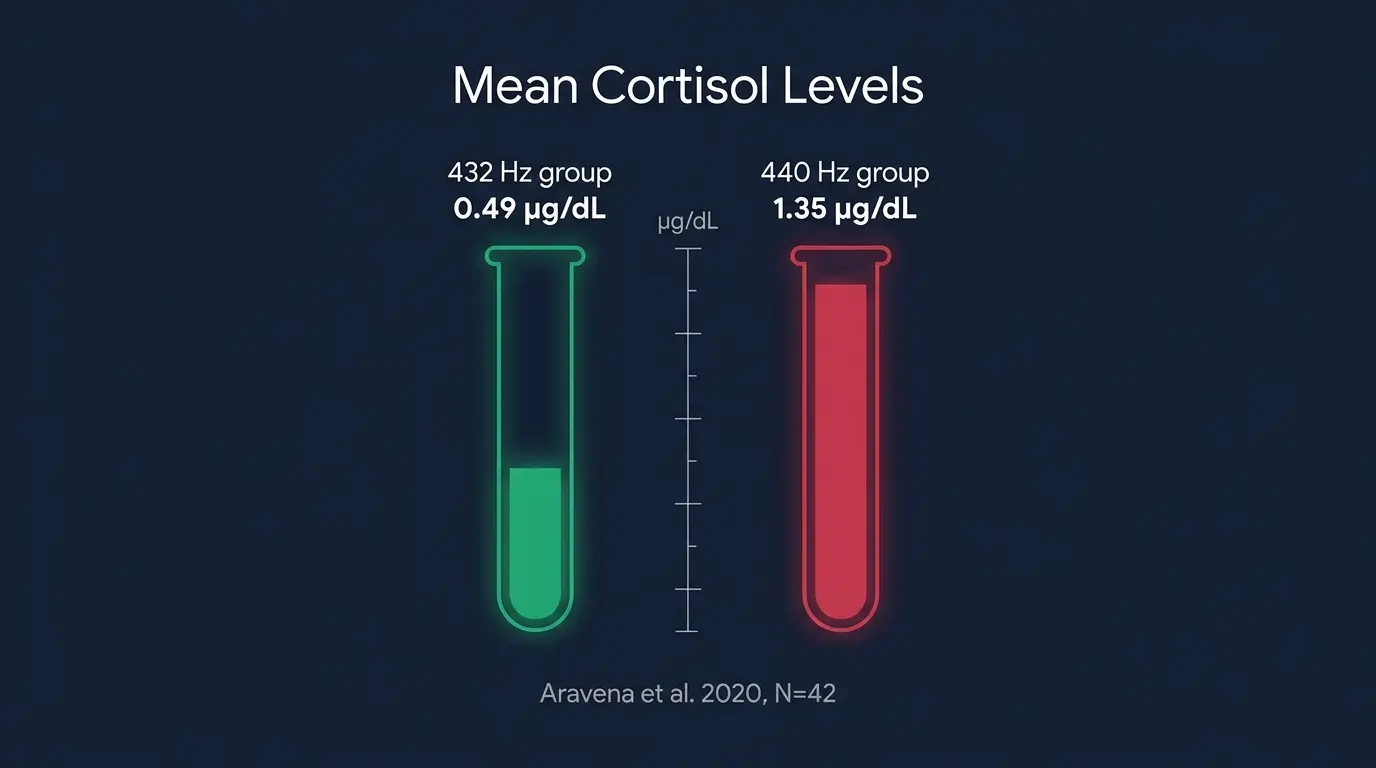
The most concrete human data we have involves 432 Hz. A randomized clinical trial in the Journal of Applied Oral Science (Aravena et al. 2020, 42 participants) found salivary cortisol at 0.49 µg/dL in the 432 Hz group versus 1.35 µg/dL in the 440 Hz group. A 64% difference from an 8 Hz tuning change. A second study by Calamassi and Pomponi (2022, N=60) found 432 Hz reduced respiratory rate by 2.7 breaths per minute and systolic blood pressure by 3.8 mmHg. Neither study measured pineal activity. Both measured real physiology.
“The mechanism exists. The clinical evidence connecting it to pineal function specifically does not — yet.”
Calcite microcrystals in the pineal gland (Baconnier et al. 2002) have the crystallographic signature of piezoelectric activity — the structural basis for frequency hypotheses.
The Most Referenced Frequencies, Compared
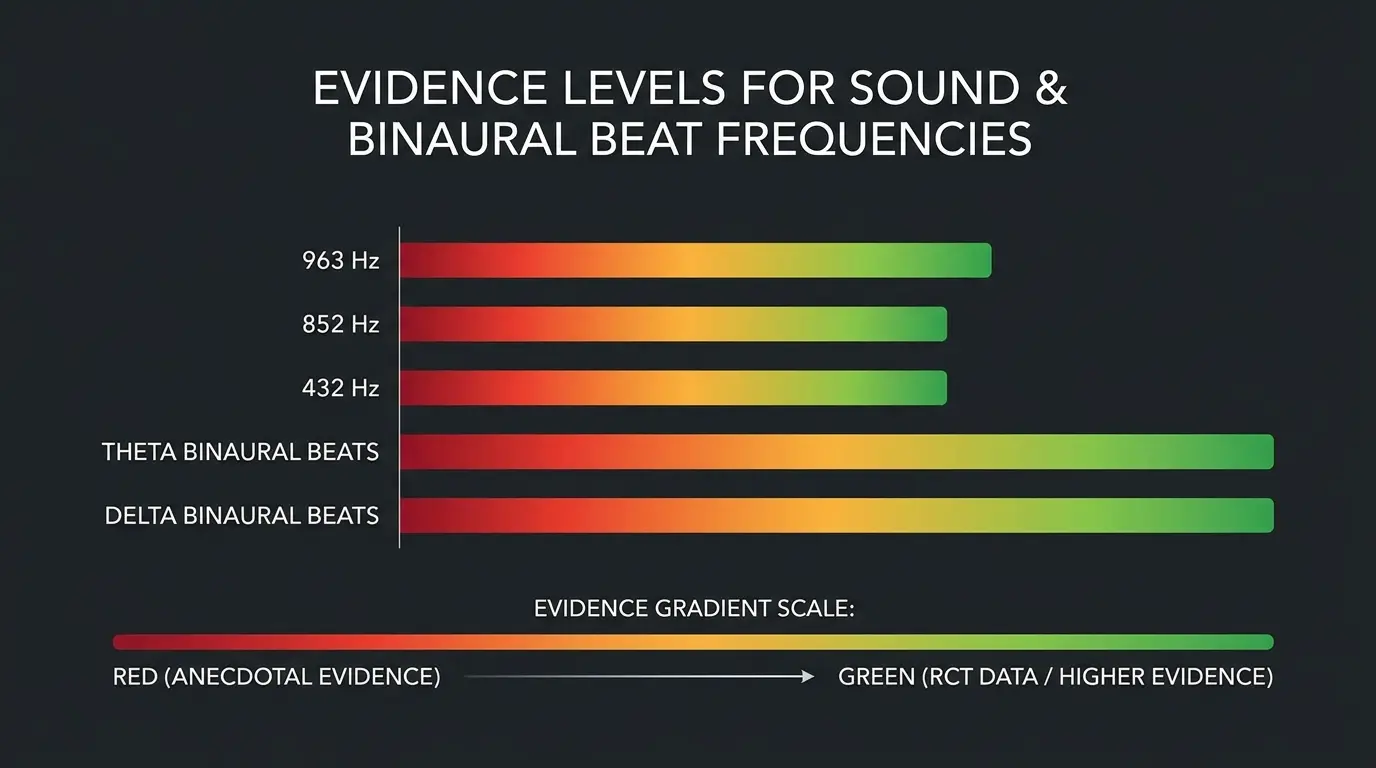
Not all frequency claims are created equal. Some have zero human data behind them. Some have a single small RCT. Some, like theta binaural beats, have been tested in 22+ studies, though the results are considerably more mixed than most meditation channels suggest. Here’s where each actually stands.
Evidence strength varies dramatically across pineal activation frequencies — from anecdotal claims to peer-reviewed RCT data.
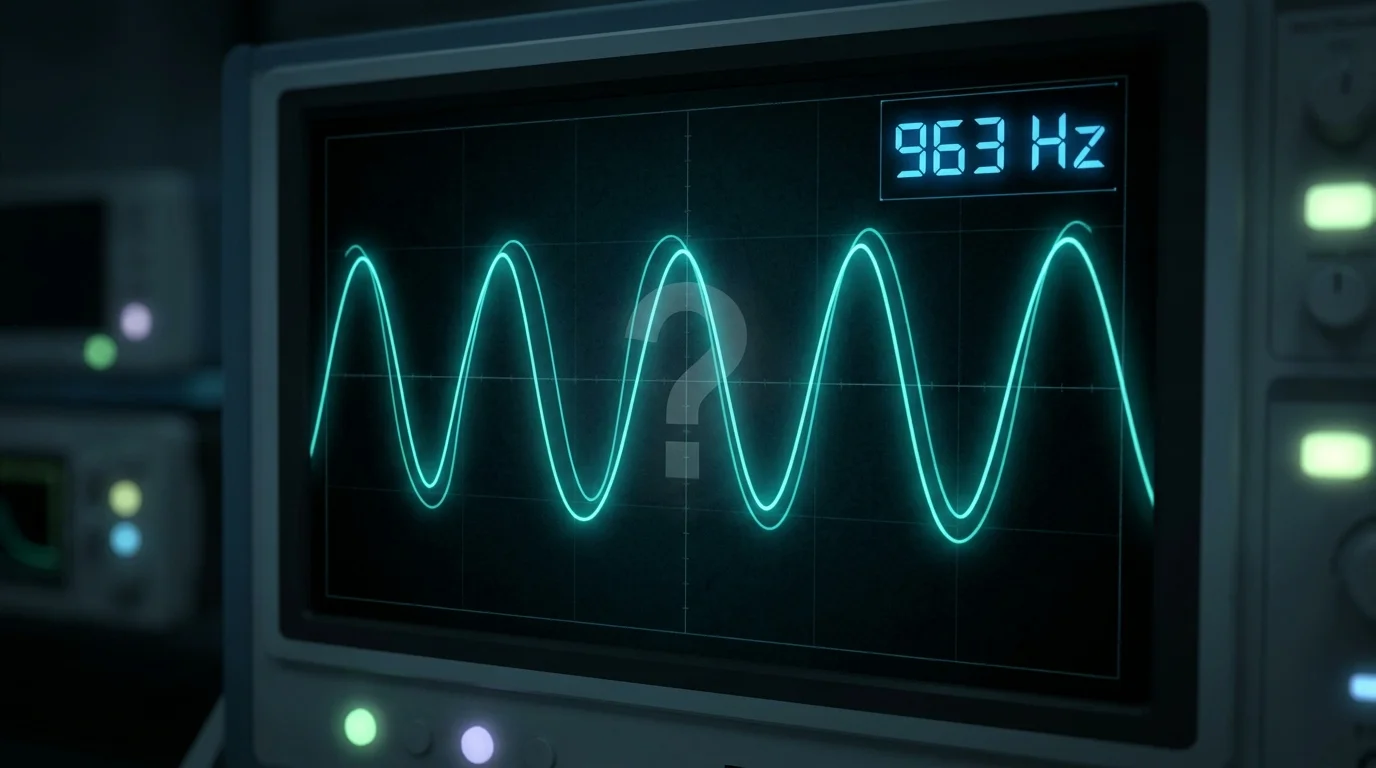
963 Hz is the most referenced pineal activation frequency in the Solfeggio system, yet zero peer-reviewed studies have measured its direct effect on pineal activity or melatonin output in living humans.
The claim rests on a 1999 book by Joseph Puleo and Leonard Horowitz, Healing Codes for the Biological Apocalypse, which derived these frequencies numerologically from biblical texts. Not from medieval acoustic tradition, and certainly not from biophysics. The Solfeggio scale Guido d’Arezzo created in the 11th century used syllables for pitch teaching. The concept of Hertz didn’t exist then. Calling 963 Hz “ancient” is a modern invention. That said: among the Solfeggio frequencies, 963 Hz has the most defensible piezoelectric argument, since higher cycles per second theoretically produce stronger crystal vibration. Plausible. Not confirmed.
852 Hz sits one tier below, positioned as the “third eye frequency,” the intuition activator, the chakra ājñā resonance. No independent study has tested 852 Hz alone. Its evidence base is identical to 963 Hz: strong cultural tradition, no clinical data. It’s commonly stacked sequentially with 963 Hz in playlists, which makes isolating any effect essentially impossible.
432 Hz is the outlier of this group and deserves more credit for what it actually is: the only frequency here with published human physiology data. Not pineal data. But real endocrine and autonomic data. The cortisol findings from Aravena 2020 and the cardiovascular findings from Calamassi 2022 are repeatable, peer-reviewed, and specific. The claim that 432 Hz is the “natural tuning of the universe” remains numerology. The relaxation effect is not.
Binaural beats (theta and delta) are the most scientifically grounded category overall. A 2023 systematic review in PLOS ONE analyzed 14 binaural beat studies: 5 confirmed brainwave entrainment; 8 reported contradictory results. A 2025 pilot study published in Oxford SLEEP found that delta binaural beats (1–4 Hz) significantly increased time in N3 deep sleep (p=0.033). A 2022 PMC study showed delta beats reduced sleep onset latency and improved overall sleep quality in healthy young adults. The entrainment mechanism is real. Whether it specifically activates the pineal gland, as opposed to the cortex, is still a chain of plausible inferences.
If the pineal gland is just a passive hormone dispenser, why does it have more blood flow per gram than almost any other structure in the brain? That question doesn’t have a clean answer. And it’s worth sitting with.
Aravena et al. (2020, N=42): salivary cortisol at 0.49 µg/dL in the 432 Hz group versus 1.35 µg/dL at 440 Hz — a 64% difference from an 8 Hz tuning change.
What Frequency Is Best for the Pineal Gland?
The honest answer depends entirely on your goal. No single frequency has been proven “best” for the pineal gland in a clinical trial. But based on available evidence, theta binaural beats (4–8 Hz) have the most consistent scientific support for influencing the brain states associated with deep meditation and indirect pineal activity.
Here’s the breakdown by objective:
Goal
Recommended Frequency
Why
General meditation / beginners
Theta binaural (4–8 Hz)
Verified entrainment mechanism; lowest barrier to entry
Spiritual practice / third eye
963 Hz
Strongest alignment with pineal claim in Solfeggio tradition
Sleep and melatonin support
Delta binaural (0.5–4 Hz)
Sleep architecture data; N3 improvement confirmed
Anxiety and stress reduction
432 Hz
Cortisol RCT data — Aravena 2020, replicated in autonomic markers
Full Solfeggio exploration
852 Hz → 963 Hz sequential
Established chakra progression; no independent clinical data
A note on the “God Frequency” dominance online: 963 Hz gets the most search volume, the most YouTube views, and the most spiritual credibility because the piezoelectric argument gives it more surface area for plausibility than other Solfeggio frequencies. That’s not the same as evidence. The gap between those two things is where a lot of people spend a lot of time, and money.
Practically speaking, the best frequency is the one you’ll use consistently. Low volume. Darkness. Focused attention. Three to five times a week. Consistency beats optimal selection in almost every behavioral intervention studied, and there’s no reason to think acoustic practice is different. For a more detailed individual Hz breakdown, see our dedicated frequency comparison.
How Do You Stimulate Your Pineal Gland with Sound?
Start with headphones. If you skip that step, binaural beats simply don’t function. The effect requires separate signals in each ear. Everything else is secondary to this.
Headphones are mandatory for binaural beats. Two speakers in a room mix the signals before they reach your ears, collapsing the perceived beat frequency entirely. Solfeggio carrier tones (963 Hz, 852 Hz) can technically be played on speakers, but you lose the entrainment mechanism.
Volume: stay below 60 dB. The physiological effect isn’t proportional to loudness. High sustained volume is counterproductive to the parasympathetic state you’re attempting to build.
Session length: 15–30 minutes, 3–5x per week. Start at 15 minutes and build gradually. The sleep improvement studies used protocols in this range. Longer isn’t necessarily more effective.
Environment: darkness or eyes closed, seated or reclined, no competing stimulation. Notifications off, no background conversation, the kind of conditions where your pineal gland is already primed to produce melatonin. For the sleep-melatonin connection, see how decalcification affects nighttime pineal function.
Timing: before sleep or within the first 20 minutes of waking. These windows align with natural circadian peaks in pineal sensitivity.
Progression option: 852 Hz then 963 Hz. A common Solfeggio sequencing used in spiritual practice. No clinical data supports this specific order, but it has the most community consistency as a protocol.
One thing most guides skip: the audio file quality matters. MP3 compression at 128 kbps distorts high-frequency precision, which means many popular YouTube meditation tracks may not deliver the exact Hz they advertise. This is a legitimate complaint across r/Meditation and r/ThirdEyeOpen communities, and it complicates interpretation of any anecdotal report. Use lossless audio files when accuracy matters to you.
Binaural beats require headphones: two slightly different tones (one per ear) produce a perceived third frequency that guides brainwave oscillations toward theta or delta states.
What Science Still Doesn’t Know
Here’s the honest accounting. No randomized controlled trial has measured the effect of any Solfeggio frequency (963 Hz, 852 Hz, 528 Hz, any of them) on the functional activity of the human pineal gland. Not on melatonin output. Not on neuroimaging. Not on pineal-specific biomarkers of any kind.
The piezoelectric mechanism is structural, not functional. Baconnier 2002 confirmed the crystals are there and have the right crystallographic properties. No experiment has demonstrated that headphone-delivered audio frequencies generate measurable electrical activity in those crystals in a living human. Structure confirmed. Function in vivo: unconfirmed. These are different claims.
Binaural beats affect cortical oscillations. That’s what EEG records. The inference chain from “theta state” to “pineal activation” to “melatonin shift” is plausible at every step, but it hasn’t been measured as a connected sequence from beginning to end.
The Solfeggio scale itself was assembled numerologically, not acoustically, not historically. There is no physical principle explaining why 963 Hz would produce a categorically different biological effect than 962 or 964. The specificity is a convention. Worth noting.
I’ve had experiences I can’t explain with a PubMed search. I also won’t pretend the published data says something it doesn’t. Here’s where the evidence stops. And here’s where we’re genuinely waiting for someone to run the study.
As research evolves, this guide gets updated.
What This Means for You
Here’s the map of where we actually are.
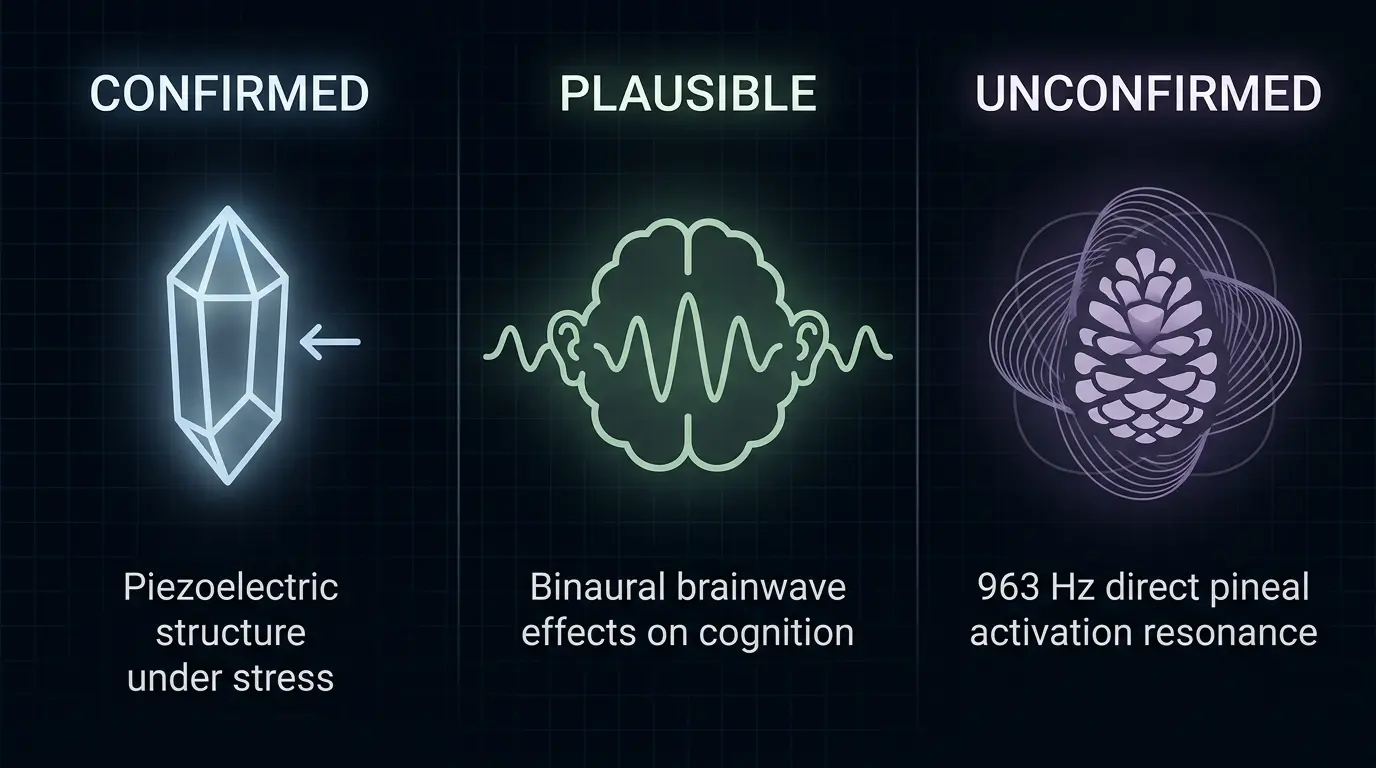
Piezoelectric mechanism: real structural finding, unconfirmed in vivo function. The 432 Hz cortisol effect: real peer-reviewed data, unexplained mechanism, no pineal-specific replication yet. Binaural beats for sleep and theta states: moderate evidence, inconsistent across studies but with genuine sleep architecture data. 963 Hz as the dominant pineal frequency: culturally embedded, biologically plausible, clinically unconfirmed.
None of that is a reason to dismiss this space.
It’s a reason to enter it with accurate expectations rather than inflated ones.
If you want one place to start: delta binaural beats before sleep. It has the most direct evidence, the lowest risk profile, and the most tangible daily outcome — deeper sleep, which is the primary documented function of your pineal gland every single night. Build that baseline first. Everything else is worth exploring from there.
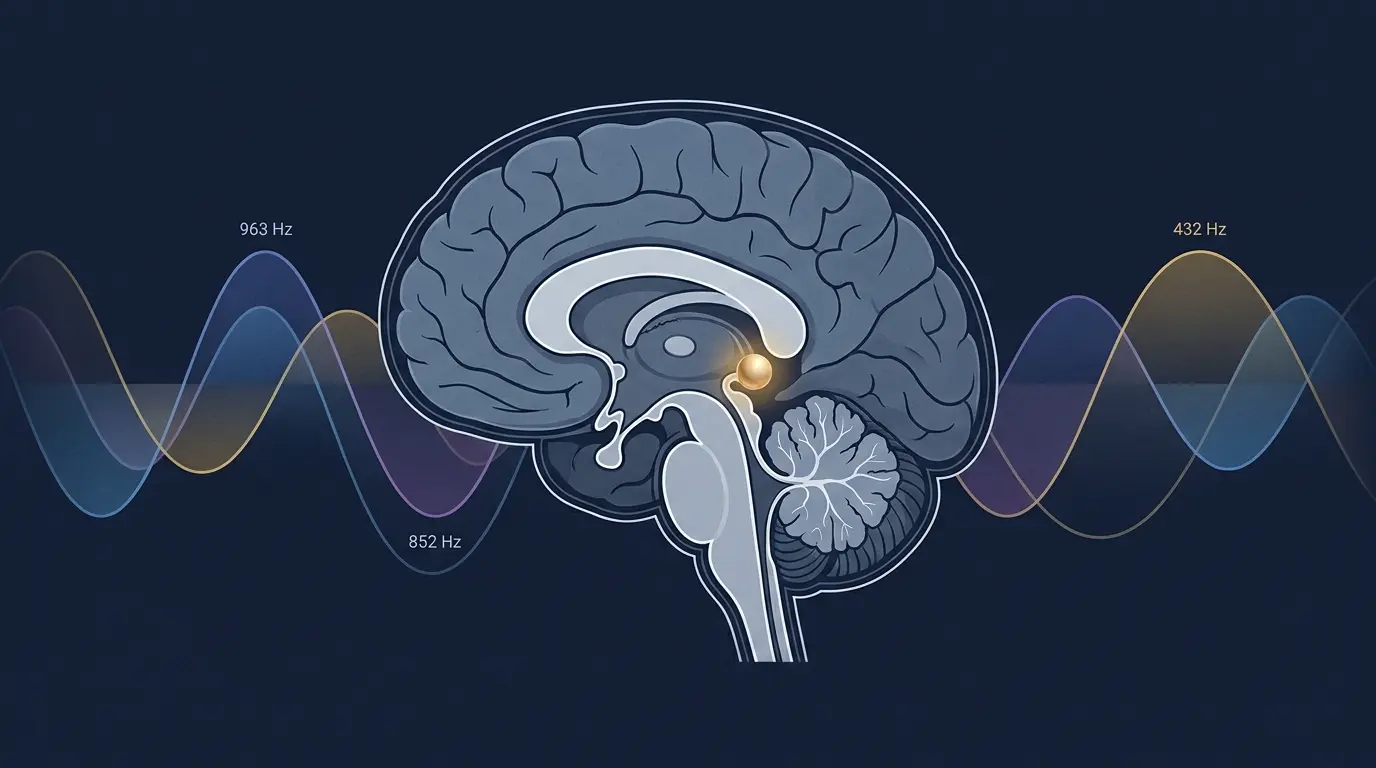
Evidence map: from confirmed structural mechanisms (piezoelectricity) to plausible inference chains (binaural beats) to culturally strong but clinically unconfirmed claims (963 Hz direct activation).
Frequently Asked Questions
What frequency activates the pineal gland?
963 Hz is the most widely referenced pineal activation frequency, linked to the piezoelectric properties of the gland's calcite crystals. Theta binaural beats (4–8 Hz) have the strongest scientific support for influencing brain states associated with deep meditation and indirect pineal activity.
What Hz is best for the pineal gland?
For spiritual practice: 963 Hz. For sleep and melatonin support: delta binaural beats (0.5–4 Hz). For relaxation with clinical backing: 432 Hz, which reduced salivary cortisol 64% versus 440 Hz in Aravena et al.'s 2020 RCT (N=42). No single frequency has been confirmed in a human trial as definitively best for pineal activation.
Can binaural beats activate the pineal gland?
Binaural beats reliably influence brainwave patterns, tested in 22+ studies, with roughly half confirming entrainment, promoting theta and delta states associated with melatonin production and deep meditation. Whether this directly activates the pineal gland has not been measured in a clinical setting, but the indirect pathway is biologically plausible.
Does 963 Hz activate the pineal gland?
No peer-reviewed study has confirmed direct pineal gland activation from 963 Hz. The claim is rooted in the Solfeggio system and the piezoelectric properties of pineal calcite crystals first characterized in 2002. It remains biologically plausible, more so than most other Solfeggio frequencies, but is scientifically unconfirmed.
Marcus Hale is an independent researcher and former clinical neuroscientist.
The content on PinealCode.com is for informational purposes only and does not
constitute medical advice.
Medical Disclaimer: The content on
PinealCode.com is for informational and educational purposes only. Nothing here
constitutes medical advice, diagnosis, or treatment. Always consult a qualified
healthcare provider before making changes to your health regimen.
Marcus Hale
Independent Researcher · Former Clinical Neuroscientist
I spent 12 years in clinical neurology before the questions got more interesting
than the answers. PinealCode is where I document what I find at the intersection
of brain science and consciousness.