What Frequency Stimulates the Pineal Gland? Not 963 Hz.
By Marcus Hale··Updated March 17, 2026
There’s a number that shows up constantly in pineal gland conversations online.
963 Hz. Sometimes 852 Hz. Sometimes 40 Hz. Sometimes all three, stacked in a
YouTube video with a slow-moving mandala and 12 million views.
Here’s what the actual research shows — and what it doesn’t.
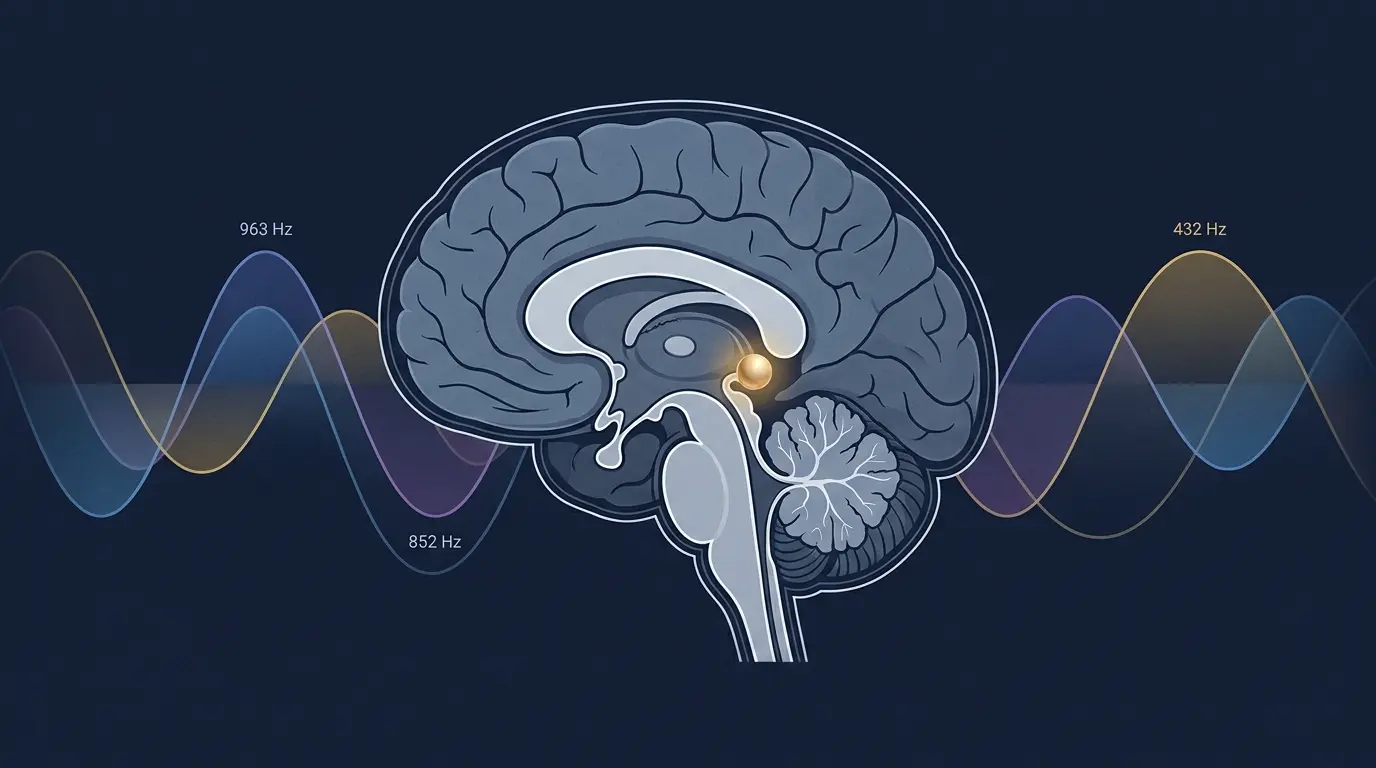
Brainwave frequencies (theta 4–8 Hz, gamma 40 Hz) vs carrier tones (963 Hz solfeggio) — different mechanisms, different effects on pineal-related neural states.
The short version: no single hertz frequency has been proven to directly
stimulate the pineal gland in living humans. But that’s not the whole story.
Brainwave entrainment — specifically theta frequencies around 4–8 Hz and gamma
at 40 Hz — does measurably shift neural oscillations in ways that may support
the states people associate with pineal activity. The 963 Hz and 852 Hz
solfeggio tones sit in a different category: culturally significant,
neurologically understudied, and not without some supporting logic.
What you do with that depends on what you’re actually looking for.
What Hertz Frequency Stimulates the Pineal Gland?
No single frequency has been proven in controlled human studies to directly
stimulate the pineal gland. The most research-supported candidates are brainwave
frequencies — theta (4–8 Hz) and gamma (around 40 Hz) — which measurably
influence neural oscillation patterns linked to deep meditative states and
cognitive clarity. On the cultural and spiritual side, 963 Hz is the most
commonly cited solfeggio tone associated with pineal activation, followed by
852 Hz for third-eye work specifically.
The distinction matters. Theta and gamma are frequencies your brain produces
— and binaural beats can nudge your brain toward producing them. 963 Hz is a
carrier frequency you listen to, with indirect effects on neural state and
very little hard data on pineal tissue specifically.
Both can be useful. Neither is magic. And the mechanism underneath them is more
interesting than the myths around them.
The Science of Brainwave Entrainment
Here’s what’s actually happening when you put on headphones and press play on a
“pineal activation” track.
Brainwave Frequency Spectrum
Neural oscillations measured in hertz (Hz) — only theta and gamma are pineal-relevant
DELTA
0.5–4 Hz
Deep sleep, unconscious processing
THETA
4–8 Hz
Deep meditation, pineal-linked states — most research-supported for entrainment
⚠️ Key Distinction: Theta (4–8 Hz) and Gamma (40 Hz) are brainwave frequencies your brain produces — binaural beats nudge your brain to produce them. 963 Hz and 852 Hz are carrier tones you listen to — indirect effects, different mechanism.
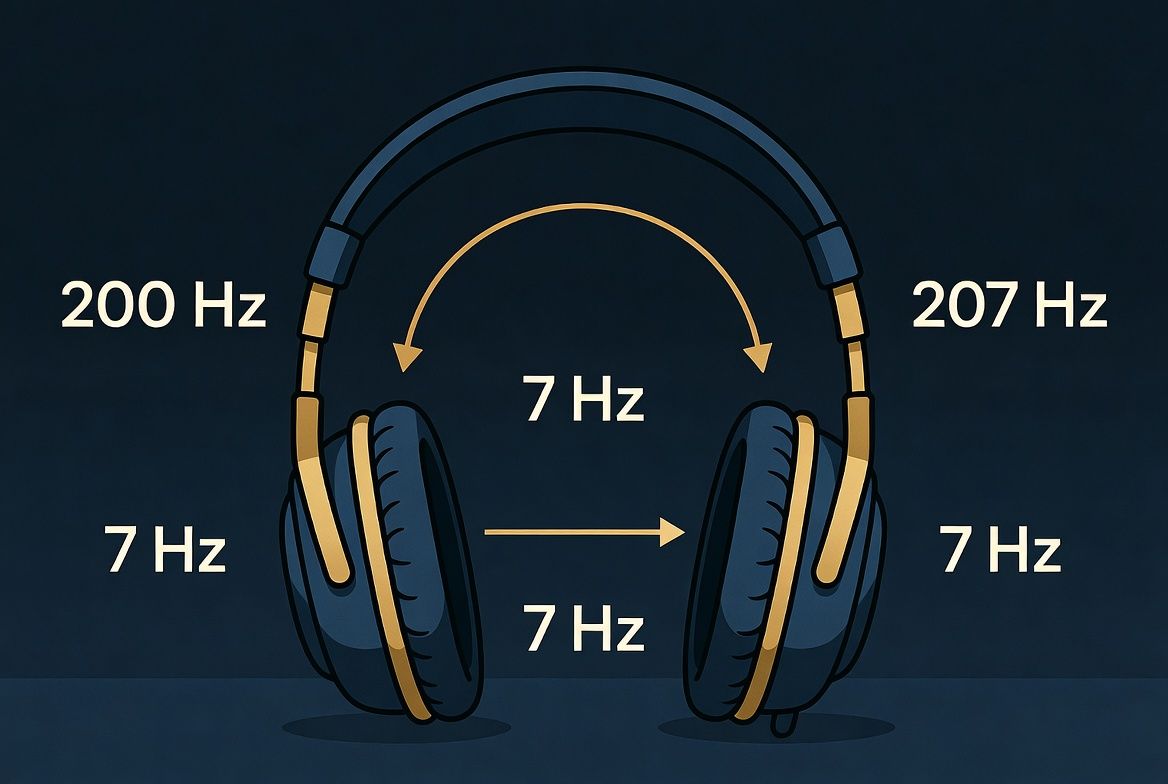
Binaural beats work like this: one tone plays in your left ear, a slightly
different tone in your right. If you hear 200 Hz in one ear and 207 Hz in the
other, your brain perceives a phantom beat at the difference — 7 Hz. That’s a
theta frequency. And the brain, being the pattern-matching organ it is, tends
to synchronize its own oscillations toward that perceived beat — a process called
brainwave entrainment, which has been studied in EEG labs since the 1970s.
Binaural beats mechanism: 200 Hz left ear + 207 Hz right ear = 7 Hz theta perception in the brain — the frequency difference, not the carrier tones, drives neural entrainment.
A 2023 systematic review analyzing 70 studies on binaural beats confirmed that while they can steer brain oscillations toward target frequencies, the effects are inconsistent — duration, volume, individual neurology, and baseline mental state all affect outcomes. There’s no
“guaranteed dose” that works for everyone.
So: binaural beats move brainwaves. Brainwaves affect subjective states —
relaxation, focus, perception. Whether that constitutes “pineal stimulation”
depends entirely on how you define the term.
Nobody in mainstream neuroscience would use that phrase. Which is either honest
or convenient, depending on how long you’ve been paying attention.
What the Research Says About 40 Hz (Gamma) Stimulation
Does 40 Hz gamma stimulate the pineal gland? Not directly — but the case for
gamma being genuinely useful to brain health is stronger than almost anything
else in this space.
MIT’s Aging Brain Initiative building evidence that 40 Hz reduces neurodegeneration markers has produced Phase II clinical data showing significant slowing of brain atrophy and cognitive improvements in Alzheimer’s patients exposed to 40 Hz light and sound. The mechanism isn’t mystical: 40 Hz gamma oscillations
appear to coordinate neural activity across brain regions and may stimulate
glymphatic clearance — the brain’s waste-removal system.
Gamma entrainment at 40 Hz has demonstrated measurable reductions in cortical
atrophy and improved cognitive performance in Phase II clinical trials — making
it the only auditory stimulation frequency with direct evidence of structural
brain benefit in humans.
Actual clinical trial data. It doesn’t mean 40 Hz opens your third eye. It
means 40 Hz gamma may support overall brain health in ways that indirectly
influence every function that runs through the brain — including whatever the
pineal gland is doing.
A 2021 study by Aparecido-Kanzler et al. in Salud Mental found that 10
minutes of 40 Hz stimulation can modulate gamma oscillations involved in
cognitive processing and subjective well-being. Not pineal-specific. But if
you’re looking for a frequency with real evidence behind it, this is your
best bet.
852 Hz and 963 Hz — The Solfeggio Angle
What frequency activates the pineal gland spiritually? That’s where solfeggio
frequencies enter the picture — and where the honest answer gets complicated.
963 Hz is labeled the “frequency of the divine” or “God frequency” in solfeggio
traditions. It’s associated with the crown chakra, higher states of awareness,
and — in pineal-focused communities — direct activation of the third eye.
852 Hz sits one step below, linked specifically to third-eye opening and inner
perception.
The cultural lineage here is real — and then again, maybe I’m overstating that.
The practice of using sustained tones in meditation is genuinely ancient —
Buddhist, Hindu, older shamanic traditions where vocal frequencies were used
to induce altered states. But the specific 852 and 963 Hz assignments are not
ancient at all. Most trace to Gregorian chant scholarship reinterpreted in the
1990s, filtered through Dr. Joseph Puleo’s work on solfeggio frequencies. The
meditation is old. The hertz numbers are a modern gloss.
A 2022 review published by Singapore Management University researchers on
chanting and solfeggio frequencies found that structured sound practices do
modulate basic brainwave states — delta, theta, alpha. The mechanisms overlap
with what we know about binaural beats.
But — and this is the part most YouTube videos skip — there is no EEG-controlled
study examining specifically what 852 Hz or 963 Hz does to the human brain as
isolated tones. The solfeggio literature lumps frequencies together, references
“432 Hz music” as a category, and doesn’t break out individual carrier
frequencies with the kind of rigor that would satisfy a peer reviewer.
That doesn’t mean they don’t work. It means we don’t know why if they do.
852 Hz and 963 Hz solfeggio tones: culturally significant in meditation traditions, neurologically understudied — no isolated EEG studies exist for these specific carrier frequencies.
What Frequency Cleans the Pineal Gland?
There is no frequency — at any hertz — proven to reverse pineal calcification
in humans. Full stop.
“Cleaning” the pineal gland in the sense of removing calcium deposits
(hydroxyapatite crystals that accumulate with age and fluoride exposure) is a
physiological process that sound waves can’t accomplish through
headphone-delivered audio. The frequencies involved in actual tissue-level
effects — ultrasound used medically, for instance — operate at entirely
different intensities and delivery mechanisms.
Frequencies can support the states associated with a healthy pineal.
They can’t scrub the hardware.
Can Music Activate the Pineal Gland?
Music and structured sound can shift your brain into theta and alpha states —
and those states correlate with the kind of deep, inward perception people
typically describe as “third eye activation.” So in that indirect sense: yes.
Music therapy research consistently shows that structured auditory input affects
autonomic nervous system regulation, cortisol levels, and subjective states of
awareness. When someone meditating to 963 Hz reports a shift in how they’re
perceiving their own mind, something real may be happening neurologically —
just not something we can currently locate in the pineal gland with any imaging
technology.
Oliver Sacks spent decades documenting how music reaches neural circuits that
nothing else can touch. He wasn’t writing about pineal glands specifically.
But the observation stands.
The honest frame: frequency-based meditation creates conditions your nervous
system finds conducive to certain experiences. Whether those experiences are
“pineal-activated” or simply deeply relaxed and focused is a semantic question
that neuroscience hasn’t resolved.
Call it theta state. Call it pineal activation. The label matters less than
the practice.
The Real Mechanism — How Sound Reaches the Pineal
Here’s the part that actually connects sound to the pineal gland — and it’s
more indirect than the frequency charts suggest.
That tells us something: the pineal responds to neural signaling. And brainwave
entrainment — through binaural beats or sustained tonal meditation — influences
the neural environment that communicates with the pineal via the sympathetic
pathway. The chain is long: audio → brainwave shift → autonomic state change
→ sympathetic signaling → potential pineal response.
It’s not direct. It’s not proven end-to-end in humans. But it’s not nothing,
either.
How to Use Frequencies Practically
Here’s the recommendation most people in this space won’t want to hear: if you
have 20 minutes, spend them on theta binaural beats before you spend them on
963 Hz tones. The entrainment mechanism is documented. The effects are
reproducible. 963 Hz feels more significant. But feelings are not
peer-reviewed data, and that distinction matters when you’re trying to build
a consistent practice.
Choose your target state first, then pick the frequency:
Theta (4–8 Hz binaural beats) — this is the workhorse. Deep relaxation,
meditative absorption, the state most consistently associated with traditional
third-eye practices and with what the entrainment research actually measures.
If you use only one protocol, make it this one.
963 Hz solfeggio — sustained tonal meditation, traditionally linked to
crown and pineal; works as a carrier tone with or without binaural overlay
40 Hz gamma — cognitive clarity, neural health. The MIT data is real.
Just don’t expect it to feel like much.
Use headphones for binaural beats — they require stereo separation to work.
For solfeggio tones, speakers are fine.
Duration matters. The Aparecido-Kanzler data shows 6–9 minutes for measurable
theta entrainment. Plan for a minimum 15–20 minute session if you want to move
through light alpha into sustained theta.
Don’t expect dramatic results in week one. The people who report the most
consistent effects from frequency meditation are, almost universally, people
who’ve been doing it for months.
Frequency meditation setup: Headphones + theta/gamma binaural beats + consistent practice over 8–12 weeks — the timeline research-supported practitioners report first effects.
Frequencies + Supplements — A Combined Protocol
A lot of people exploring frequency work also use pineal-targeted supplements
— and the combination isn’t irrational. The logic is parallel support:
frequencies to shift neural state, supplements to address the physiological
environment of the pineal gland.
Pineal Guardian is one of the more commonly used options
in this community, with a formulation oriented toward pineal support rather
than making direct activation claims. If you’re building a consistent practice
around frequency meditation, adding a targeted supplement is a conversation
worth being direct: supplements won’t replace the practice. No capsule entrains
your brainwaves. And frequency meditation won’t undo a poor nutritional
foundation. If you’re looking to do this properly, the combination works better
than either alone.
Combined protocol: Frequency meditation (theta/gamma entrainment) + pineal-targeted supplementation — parallel support for neural state and physiological environment.
Frequently Asked Questions
What hertz frequency stimulates the pineal gland?
Most research points to brainwave frequencies like theta (4–8 Hz) and gamma (around 40 Hz) having a measurable effect on brain states linked to pineal activity, while 963 Hz Solfeggio is the most spiritually associated tone used for pineal activation.
What frequency cleans the pineal gland?
There is no scientifically proven 'cleaning' frequency; pineal decalcification relies mainly on diet, fluoride reduction, and detox practices, not sound alone.
Can music activate the pineal gland?
Music and binaural beats can shift brainwaves toward theta and alpha states that support deep meditation, making it feel like the pineal is activated, but this is an indirect effect rather than direct stimulation.
Does 40 Hz gamma stimulate the pineal gland?
40 Hz gamma stimulation is shown to improve brain health and neural activity, which may indirectly support pineal-related consciousness states, but it has not been proven to directly stimulate the gland itself.
Marcus Hale is an independent researcher and former clinical neuroscientist.
The content on PinealCode.com is for informational purposes only and does not
constitute medical advice.
Medical Disclaimer: The content on
PinealCode.com is for informational and educational purposes only. Nothing here
constitutes medical advice, diagnosis, or treatment. Always consult a qualified
healthcare provider before making changes to your health regimen.
Marcus Hale
Independent Researcher · Former Clinical Neuroscientist
I spent 12 years in clinical neurology before the questions got more interesting
than the answers. PinealCode is where I document what I find at the intersection
of brain science and consciousness.