Third Eye Pressure Between Eyebrows: 3 Physical Causes
By Marcus Hale··Updated April 14, 2026
You’re sitting in meditation, eyes closed, perfectly still — and then it happens: a pressure, a pulse, something pressing from inside your forehead like a thumb pushing against the space between your brows. You didn’t expect it. You didn’t try to feel it. And now you can’t unfeel it.
This is one of the most common experiences I get asked about. Not mystical visions. Not light shows. Just pressure. A physical sensation that lands somewhere between comfortable and urgent, usually localized to that specific triangular zone between your eyebrows.
The first thing you need to know: the sensation is real. You’re not imagining it. Your nervous system is reporting something legitimate happening in that region. The second thing: there are multiple valid explanations, and they’re not mutually exclusive. The internet has trained you to pick a lane — either it’s spiritual or it’s mechanical. That binary is wrong.
I’m going to walk you through exactly what’s happening in your skull, why that specific area is a neurological hotspot, and what it actually means when you feel it.
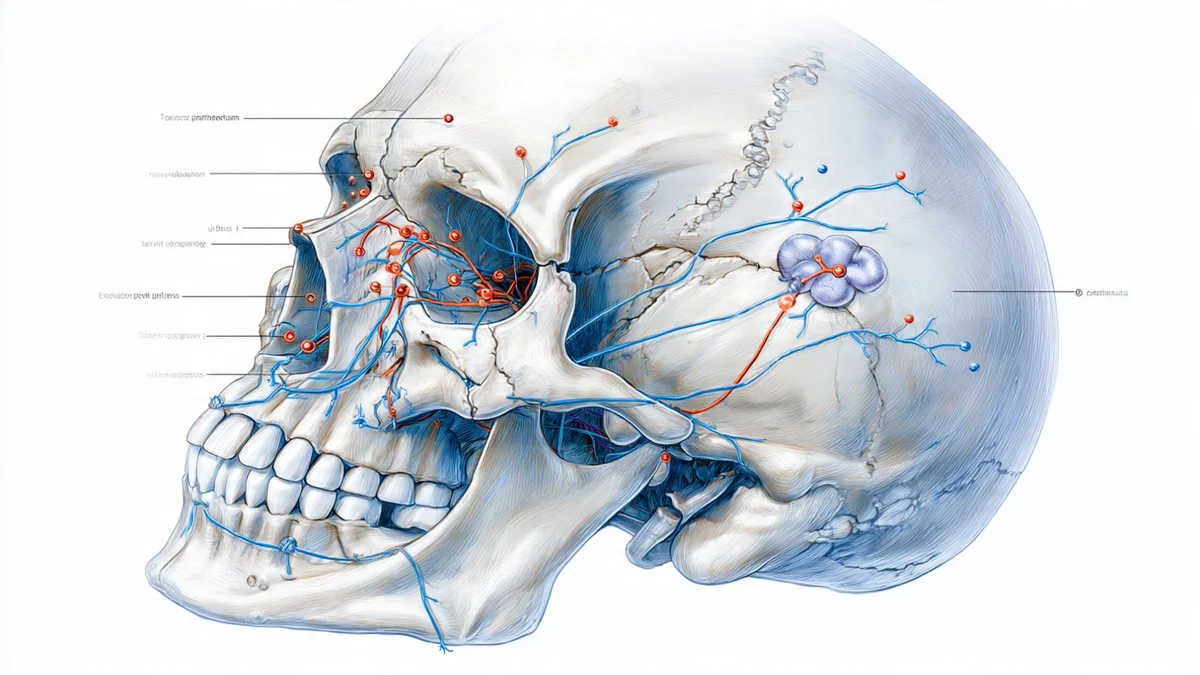
The glabella — the space between your eyebrows — is one of the most neurologically dense regions of the face
What Causes Pressure Between the Eyebrows?
The pressure between the eyebrows during meditation has at least three overlapping physical causes — and none of them require a spiritual explanation to be real and interesting.
First: the glabella region is neurologically dense. The supratrochlear nerve (a branch of the trigeminal’s ophthalmic division) runs through this area with an unusually high concentration of nerve endings. Even minor tension registers with clarity here.
Second: focused concentration causes unconscious contraction of the procerus and corrugator supercilii muscles between the brows. You don’t feel it happening because you’re focused inward. The pressure builds silently.
Third: controlled breathing during meditation shifts cerebrospinal fluid velocity and frontal blood flow — changes that create pressure-like sensations in the head, concentrated where nerve density is highest.
All three causes operate simultaneously. Understanding them doesn’t diminish the experience — it makes it easier to work with. Before assuming a spiritual cause, it is vital to rule out acute sinusitis, which commonly manifests as tenderness, swelling and pressure around the forehead and eyes.
The Anatomy of That Sensation
Your forehead isn’t just skin. It’s one of the most densely innervated regions of your face, wired directly into your trigeminal system — the same nerve that makes you flinch at a cold wind.
Why the Glabella Is Neurologically Special
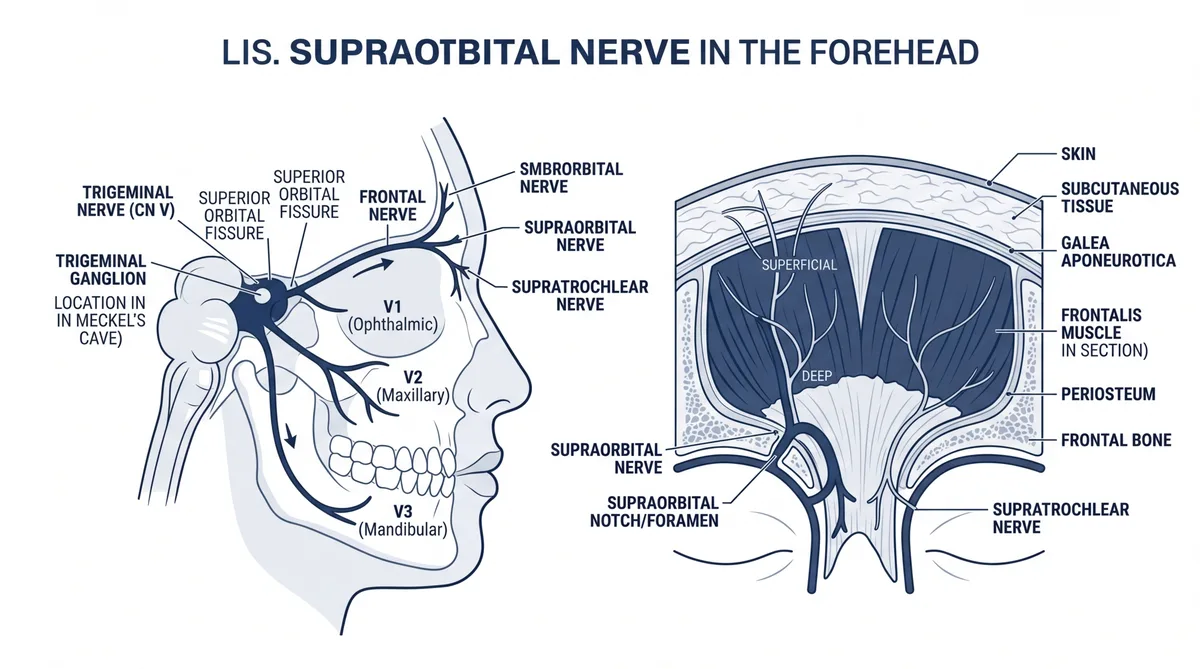
The glabella — that space between your eyebrows — is supplied by the supratrochlear nerve, a direct branch of the trigeminal nerve’s ophthalmic division (V1). This nerve doesn’t just handle sensation. It innervates the medial forehead, the upper eyelid, and extends down to the frontal sinus. Dense population of nociceptors and thermoreceptors.
According to Pham et al.’s 2019 analysis in PLOS ONE, this nerve pathway is one reason headaches and facial pain concentrate here. But more important for our purposes: this region reports internal pressure changes with unusual sensitivity. You can feel micro-shifts in blood flow, cerebrospinal fluid dynamics, and muscle tension here before you’d notice them anywhere else on your body.
The trigeminal system is also directly connected to your autonomic nervous system. It’s not just sensory. It’s reactive.
The supratrochlear nerve (V1 branch) innervates the glabella with unusual density — making this region exquisitely sensitive to internal pressure changes
The Muscle Tension Nobody Talks About
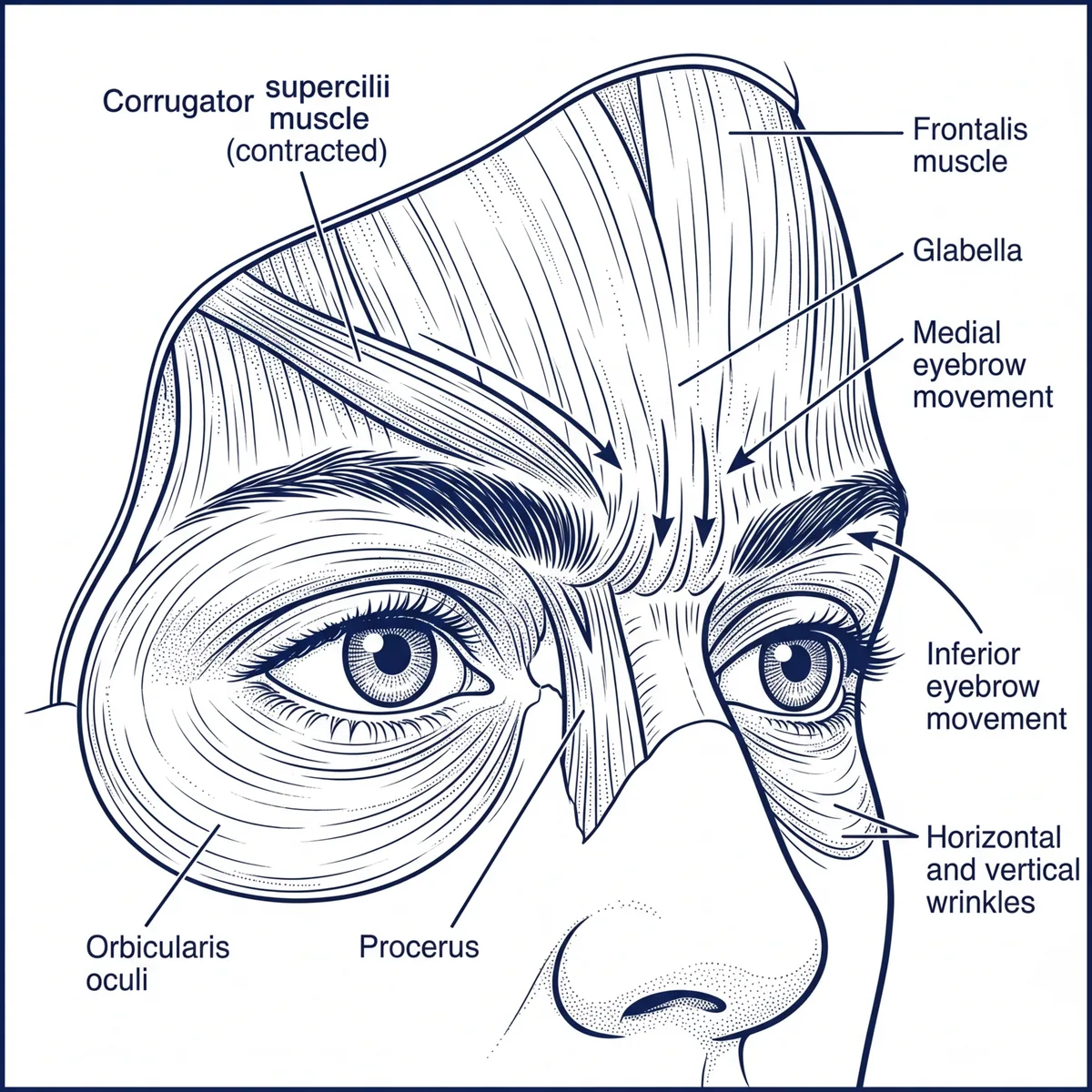
There are two small muscles between your eyebrows that most people have never heard of: the procerus and the corrugator supercilii. These muscles are responsible for frowning, for scrunching your brow. But here’s the thing — during meditation, during concentration, during any state of intense mental focus, these muscles tense involuntarily.
In clinical settings, persistent blinking in response to forehead tapping is known as Myerson’s sign, an important marker in the neurological examination for movement disorders. This reflex demonstrates just how sensitive this forehead region is to stimulation — and how its responses can reflect deeper neurological states.
Lee et al. 2019 documented this phenomenon precisely. When your attention concentrates, your facial muscles don’t relax — they contract. Especially around the eyes.
Trigger points in the procerus and corrugator don’t just cause localized tension. They refer pain directly into the glabella. They create that exact pressure sensation you’re feeling.
But this is the part that shifts everything: that muscle tension is often accompanied by changes in frontal lobe blood flow and cerebrospinal fluid dynamics. Not instead of. Alongside.
The corrugator supercilii and procerus contract involuntarily during focused concentration — building silent tension you only notice when pressure becomes unmissable
What Meditation and Breathing Do to Your Brain
Here’s where most explanations break down. They stop at the muscles. They don’t go further into what’s actually happening inside your skull.
Cerebrospinal Fluid and Pranayama
Your brain sits in cerebrospinal fluid. This fluid isn’t static. It pulses with every breath, every heartbeat, every shift in blood pressure.
Yildiz et al. 2022 measured this directly. During deep abdominal breathing — the kind you do in yoga, the kind that naturally happens in meditation — cranial cerebrospinal fluid velocity increased 16–28%. More significant: the respiratory-driven component increased 60–118% in some participants.
Eighteen healthy subjects. Real measured changes. Not theoretical.
Bhastrika breathing (the rapid fire nostril breathing practice) reduces blood carbon dioxide significantly. Lower CO2 triggers cerebral vasoconstriction — your blood vessels tighten. Kumbhaka (breath retention) does the opposite. As CO2 builds, your frontal lobes vasodilate. Blood flow increases.
Pramanik et al. 2009 in the Journal of Alternative and Complementary Medicine documented this. The physiology is straightforward. Your brain responds to breathing patterns the way a hydraulic system responds to pressure changes.
And the frontal regions — the prefrontal cortex, the area directly behind your forehead — gets a surge.
Controlled breathing increases cranial CSF velocity by 16–28% — a measurable hydraulic shift that contributes to frontal pressure sensations during pranayama
Why Do I Feel Pressure Between My Eyes When Meditating?
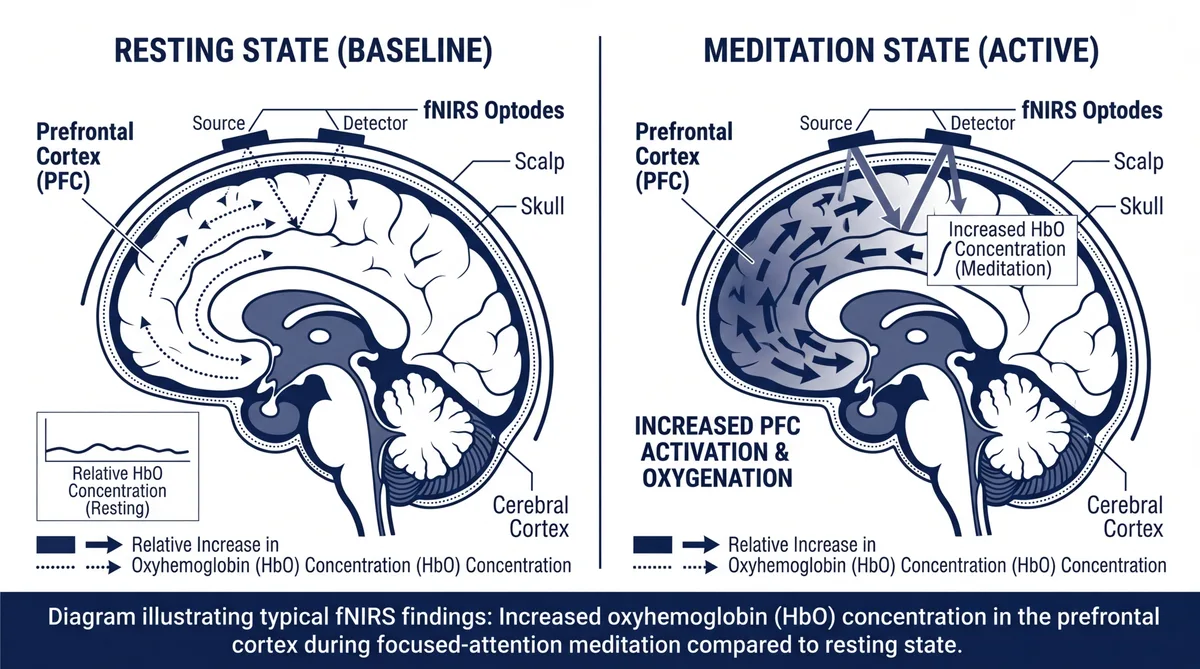
The fMRI data is consistent. When people enter focused meditation states, blood flow increases in frontal and parietal lobes. Amygdala activity decreases. This is reproducible.
Modern neuroimaging using fNIRS has confirmed that meditation leads to increased cerebral oxygenation and enhanced performance in the prefrontal cortex, providing a physiological basis for the sensation of pressure felt between the eyebrows.
But here’s the honest gap: your brain has no pain receptors. The tissue itself can’t sense increased neural activity. So the physical pressure sensation — that localized feeling between your brows — isn’t coming directly from increased brain activity. It’s coming from the surrounding tissues responding to pressure changes, blood flow changes, and muscular tension.
All three at once.
The Spiritual Framework: What Traditions Actually Say
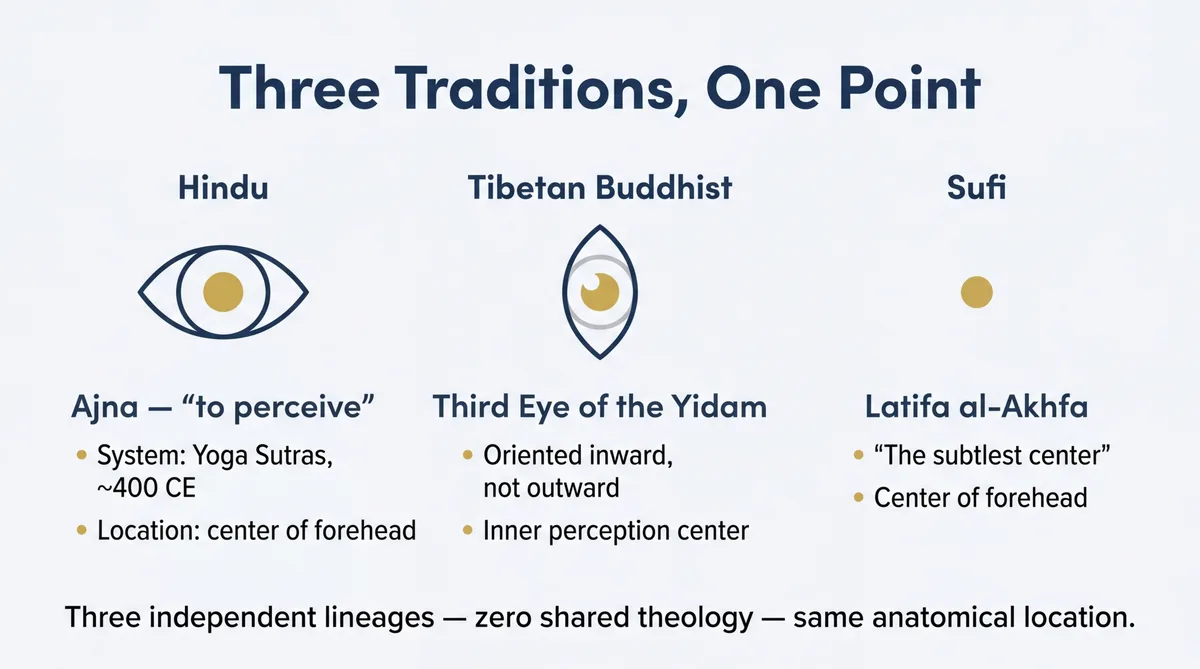
The Hindu framework places the ajna chakra — sometimes called the “third eye” — at this exact location. Not as metaphor. As a specific anatomical point.
Ajna means “command center” in Sanskrit. The literature describes it as the seat of mental command, associated with the pineal gland, pituitary gland, and hypothalamus. The endocrine control center of your entire body.
Shiva’s third eye — the mythological third eye that destroys illusion — points to the same region. Not because ancient yogis had fMRI machines. Because they spent decades paying attention to what their nervous systems reported.
Trataka — the classical meditation practice of staring at a single point, often between the eyebrows — was designed to concentrate attention and activate this region. It’s deliberate. It works.
The conceptual framework for third eye activation originates in the Yoga Sutras of Patanjali, recognized as the earliest extant textbook on Yoga, which details the eightfold path of spiritual practice leading to samadhi. The traditions weren’t randomly guessing. They were observing something consistent across thousands of practitioners over centuries.
The internet has two explanations for this: you’re achieving enlightenment, or you need to relax your face. Somehow, both camps are partially right.
The false dichotomy is “either spiritual OR muscular.” The truth is both. The muscular tension doesn’t cancel the cerebrospinal fluid flow. The increased prefrontal cortex activation doesn’t negate the trigger points in the procerus. Traditions arrived at something neurologically real, even without the vocabulary to describe it.
They were decoding the same hardware from a different instruction manual.
Is It Dangerous?
The vast majority of the time: no.
The minority of cases where it matters: yes, pay attention.
If you’re feeling pressure between your eyebrows only during meditation, and it’s not accompanied by blurred vision, tinnitus, or visual disturbances, you can relax. The sensation will fade as your nervous system habituates to the stimulation.
If the pressure is persistent throughout the day, especially if it’s new, and especially if it’s accompanied by visual changes or hearing changes, that’s different. Idiopathic Intracranial Hypertension (IIH) is rare but real. Increased intracranial pressure can produce exactly this sensation.
Sinusitis is more common. Congestion, frontal sinus pressure, a lingering cold — these can create identical sensations and they have different solutions.
The rule: if it only appears during your practice, it’s probably benign. If it’s constant, see someone who can actually examine you. There’s no moral failure in getting a checkup.
If you also experience persistent sleep disruption, brain fog, and daytime fatigue alongside the pressure, the pineal gland calcification symptoms guide covers the broader picture of what reduced melatonin production looks like.
What the Sensation Typically Means — A Practical Framework
Decode the context. This is the only tool that matters.
Three mechanisms acting simultaneously — not competition, but convergence. Understanding each helps you work with the sensation rather than mystify it
If it appears during focused meditation, particularly when you’ve been concentrating intensely on a single point: muscle tension plus increased frontal blood flow. Your nervous system is reporting what it’s supposed to report. Observation, not intervention, is the correct response.
If it emerges during pranayama — especially breath retention practices — you’re likely experiencing the CSF and blood flow changes we discussed. This is normal. It typically subsides as your CO2 returns to baseline.
If the pressure persists throughout your day, if it doesn’t correlate with meditation or breathing practice: check for chronic muscle tension. The procerus can stay contracted for hours. It’s usually from concentration, from screen time, from unaddressed stress. Myofascial release, forehead relaxation, sometimes just noticing and releasing the tension — these work.
When you do feel it during practice, the instruction is consistent across traditions: observe without attachment. Notice the sensation. Don’t grasp it. Don’t try to intensify it. Don’t treat it as evidence of progress. Pressure is pressure. It means something is happening. It doesn’t mean you’re special.
What not to do: force the sensation. Create a goal around feeling it. Treat it as a marker of achievement. These paths lead nowhere useful. The sensation will arrive or not, based on neuromuscular and hemodynamic factors beyond your direct control.
Context is the only diagnostic tool that matters — meditation-only pressure is benign; persistent daily pressure warrants evaluation
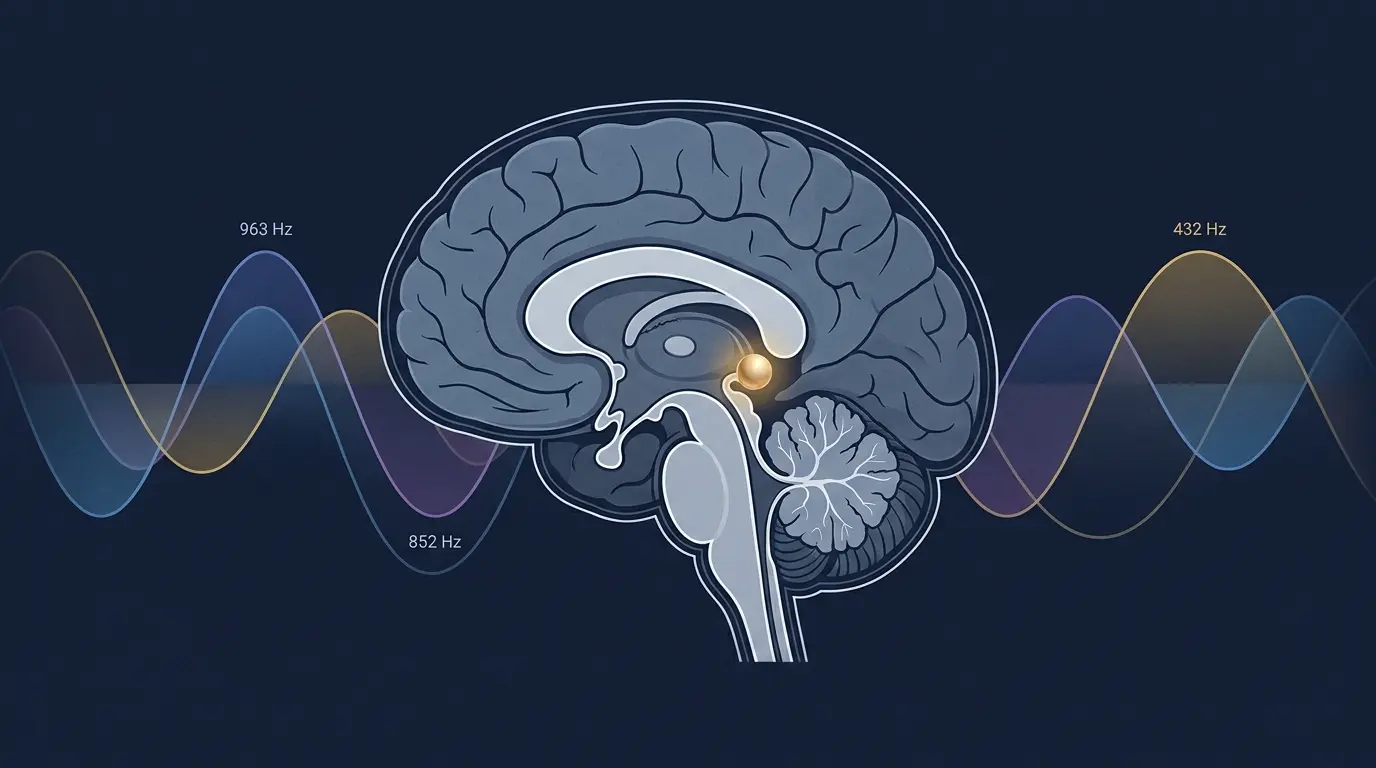
If you’re exploring broader questions about brain health and pineal gland function, our guide to decalcify pineal gland naturally covers evidence-based approaches. There’s also detailed information on what fluoride actually does to the pineal gland if that’s a concern you’re investigating. Some practitioners combine focused Ajna meditation with sound — if you’re curious whether 852 Hz frequency has any real basis, the answer is more interesting than either camp admits.
Frequently Asked Questions
What does it mean when you feel pressure between your eyebrows?
Physical pressure between your eyebrows typically indicates one or more of three things: contraction in the procerus and corrugator supercilii muscles, increased cerebrospinal fluid pressure in the frontal region, or increased blood flow to your prefrontal cortex. The trigger depends on context. During meditation, all three often occur simultaneously. The sensation itself is your trigeminal nerve reporting these internal changes accurately.
Why do I feel pressure in my forehead when meditating?
Three mechanisms produce this. First, intense concentration causes involuntary contraction of the frontalis muscles and the muscles between your eyebrows. Second, controlled breathing during meditation increases cerebrospinal fluid velocity in your cranial vault. Third, focused attention increases blood flow to your prefrontal cortex and anterior cingulate regions. Your trigeminal nerve, which densely innervates the glabella, reports all three changes as pressure.
Is third eye pressure a sign of spiritual opening?
Not inherently. Spiritual opening, in traditional frameworks, refers to a shift in perception and understanding, not to a physical sensation. The sensation of pressure is neurological feedback. It can accompany genuine shifts in how you process information and perceive reality, but the pressure itself is just the hardware reporting activity. Confusing sensation with insight is one of the oldest traps in meditation practice.
Is third eye pressure dangerous?
In isolation, during meditation, no. If pressure is constant throughout your day, especially if accompanied by visual disturbances, nausea, or hearing changes, that warrants medical evaluation to rule out intracranial hypertension. Sinus congestion can mimic the sensation and is treated differently. Context determines whether you observe or seek care.
How long does third eye pressure last?
During meditation, typically 5–30 minutes. As your nervous system habituates to the sensation and as your muscles relax, the pressure usually fades. Some practitioners report it returns whenever they resume intensive practice. Others find it disappears entirely once they stop treating it as meaningful. There's no standard timeline — your neuromuscular system is unique.
Can sinus problems cause pressure between the eyebrows?
Yes. The frontal sinus sits directly above the glabella. Congestion, infection, or inflammation creates localized pressure and referred sensation into the brow region. This differs from meditative pressure in that it's typically constant rather than practice-dependent, often accompanied by other sinus symptoms, and usually resolves with sinus drainage or treatment. The sensation is the same. The diagnosis is different.
Marcus Hale is an independent researcher and former clinical neuroscientist. The content on PinealCode.com is for informational purposes only and does not constitute medical advice.
Medical Disclaimer: The content on
PinealCode.com is for informational and educational purposes only. Nothing here
constitutes medical advice, diagnosis, or treatment. Always consult a qualified
healthcare provider before making changes to your health regimen.
Marcus Hale
Independent Researcher · Former Clinical Neuroscientist
I spent 12 years in clinical neurology before the questions got more interesting
than the answers. PinealCode is where I document what I find at the intersection
of brain science and consciousness.